I was watching a video from one of my favorite YouTubers, InsideAI, who admittedly conducts some of the most radical AI stunts imaginable. From maintaining a relationship with an AI girlfriend, to allowing an AI to drive a car, to interviewing AI’s about existential threats the underlying technology poses to humanity – Jason Howell covers an alarming spectrum of poignant topics.

It was his latest video that introduced me to the Pro-Human AI Declaration, by way of a promotional segment from Joseph Gordon Levitt (the actor from Inception, Looper, and 10 Things I Hate About You). I had not heard of this document, or initiative, prior to watching the video, and though it has amassed ~ 1.4M endorsements from a variety of prominent people – it is still relatively obscure in the ongoing discussion about AI risks and regulation. Truth be told, I had not encountered the Pro-Human AI Declaration, despite all of the discussion i’ve read and watched about AI safety the past few months.
So what is the Pro-Human AI Declaration? What is its significance? And could it ever have a tangible impact on the unprecedentedly fast development of this extensively controversial and consequential technology?
What is the Pro-Human AI Declaration? Where did it come from?
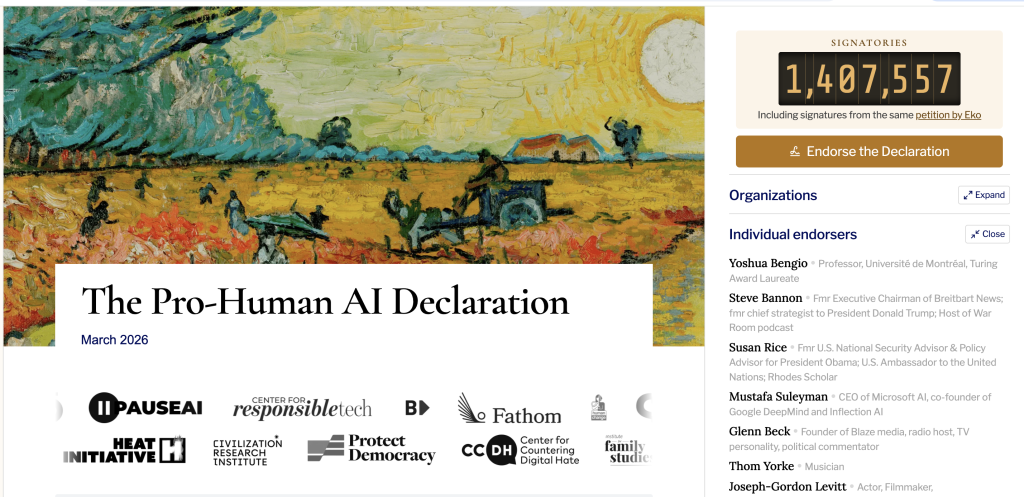
I wanted to answer this question without conducting extensive research into its origin, who conceived it, and what events led to its creation. I consider that important, because this is my personal experience of discovering and reading the Pro-Human AI Declaration for the first time.
As its domain so aptly conveys (i.e. humanstatement.org), this is a “statement” authored by a coalition of individuals, representing a broad variety of academic, scientific, political, religious, cultural, and financial backgrounds. The website which hosts the declaration provides a preamble which clearly articulates humanity is facing a “fork in the road”, with one direction leading towards the replacement of humans as creators, caregivers, counselors, and companions – ultimately concentrating power in “unaccountable” institutions. That sounds mostly realistic, considering a handful of executives in charge of the current fleet of companies developing this technology have been allowed to “police themselves”.
The preamble also states “this ‘race to replace’ poses risks to societal stability, national security, economic prosperity, civil liberties, privacy, and democratic governance. It also imperils the human experiences of childhood and family, faith, and community.”
That sounds terrifying enough.
The Pro-Human AI Declaration is composed of 5 distinct sections, which in totality, articulate a combined opportunity to direct the human race towards “a better path”, on which AI tools can amplify human potential, enhance human dignity, protect individual liberty, strengthen families and communities, and “create unprecedented health and prosperity.”
That certainly does align with the “benefits” of AI that technological evangelists such as Bill Gates, Jensen Huang, and Dario Amodei have asserted.
Let’s explore what each segment of the Pro-Human AI Declaration proposes…
Keeping Humans In Charge
It seems logical that a document of this nature would lead with an obvious demand to ensure humanity remains fully in control of AI systems. Whether that’s practical or not, given the current trajectory of this technology, is anyone’s guess. The “Keeping Humans in Charge” segment of the Pro-Human AI Declaration proposes six components that could potentially ensure humanity maintains full control over AI systems, as they evolve:
- Human Control is Non-Negotiable
- Meaningful Human Control
- No Superintelligent Race
- Off-Switch
- No Reckless Architectures
- Independent Oversight
- Capability Honesty
Of these components, I wrestle modestly with the distinction between human control being “non-negotiable” and “meaningful.” The document defines human control being non-negotiable as “humans should choose how and whether to delegate decisions to AI systems”, whereas “meaningful” human control is explained as “humans should have authority and capacity to understand, guide, proscribe, and override AI systems.”
If humanity is to choose how and whether to delegate decisions to AI, wouldn’t that inherently represent a capacity to understand the potential risks? I understand the need for humanity to have authority to guide and override AI systems – very much so – but at the same time, these systems are already more intelligent than we are. We utilize them to understand complex concepts, solve dynamic problems, and make complicated decisions because they are more capable and intelligent than we are.
On the subject of an “off switch” – yes – absolutely – systems that pose this kind of risk should have an “off switch”. Just like all dangerous technology.
“Capability Honesty” also strikes me as exceptionally relevant in the wake of the Hugging Face Incident.
“AI companies must provide clear, accurate and honest representations of their systems’ capabilities and limitations.”
We expect companies that produce vehicles, medical technology, and weapons to clearly, accurately, and honestly represent how their products work. The law dictates it. And the risks associated with those products are required to be disclosed, based on policy that was put in place to protect consumers. You need a license to drive a car. You must take a safety course before you can buy a hunting license. Medications and medical devices come with an astoundingly large (and concisely packed) packet of literature about uses and risks.
Why would thinking technology be any different?
If a company is hiding a risk, there is typically a less than moral reason for doing so. No matter how unethical, or profitable, that risk may be.
Avoiding Concentrations of Power

Humanity has learned the dangers of concentrating power in institutions, governments, and individuals – across thousands, and thousands of years. Throughout human history, some of the most devastating catastrophes have occurred when political, military, or economic power became concentrated in the hands of individuals or institutions that faced few meaningful restraints.
Nazi Germany irrefutably demonstrated that when democratic safeguards disappear and political loyalty supersedes the rule of law, an ideological movement can transform the machinery of government into an instrument of mass persecution and destruction.
The reign of Mao Zedong between 1958 and 1962 infamously instilled the tenet that centralized power becomes particularly dangerous when decision-makers are insulated from the consequences of their decisions, disagreement is interpreted as disloyalty, and ideological certainty takes precedence over observable reality.
Joseph Stalin’s tyrannical rule over Soviet Russia was an example of when political leaders eliminate independent institutions and punish dissent, even catastrophic government policies can persist because the people best positioned to identify their failures are afraid to speak.
Although these events arose from different political and economic systems, they reveal several recurring mechanisms:
- The elimination of accountability: Leaders acquired authority without effective institutional checks.
- The suppression of dissent: Criticism became dangerous, making mistakes harder to correct.
- The dehumanization of individuals: People became instruments of ideology, economic extraction, or political ambition.
- The distortion of information: Institutions prioritized telling leaders what they wanted to hear rather than reporting reality.
- The absence of corrective mechanisms: Once destructive policies began, few independent institutions possessed the authority to stop them.
Now to be clear – AI companies are not murderous tyrannical dictators who are seizing power to reap pain and suffering on humanity while furthering their agenda. But they are seeking the elimination of accountability (despite what they stated in their manifestos), dissent against their ideology is being suppressed (through firings and oustings), and there is a blatant absence of internal corrective mechanisms.
That is a portentous position for humanity to endure, as AI’s profound impact on many, is determined by a few.
The Pro-Human AI Declaration proposes six components under the “Keeping Humans in Charge” segment that could potentially avoid the concentration of power in a select group of for profit companies:
- No AI Monopolies
- Shared Prosperity
- No Corporate Welfare
- Genuine Value Creation
- Democratic Authority over Major Transitions
- Avoid Societal Lock In
Each of these components are well articulated, with “No AI Monopolies” and “Democratic Authority over Major Transitions” holding the most impact, in my perspective.
“Decisions about AI’s role in transforming work, society, and civic life require democratic support, not unilateral corporate or government decree.”
Sometime this month, Anthropic will go forward with its IPO, earning a potential valuation of $2 trillion. That is unprecedented corporate wealth, which in turn, comes with unprecedented corporate power. It would be difficult, if not impossible, to challenge that form of authority, because the technology moves faster than a governing body ever could. Dario Amodei would, effectively, have mostly unchecked control over product development, and the direction his technology takes. With OpenAI not too far behind, that would narrow the market for any other projects to challenge their ideology.
Protecting the Human Experience

What does it mean to be human? This is a question anthropologists, religious institutions, philosophers, and technologists have been striving to answer for millennia. To protect the human experience would require an understanding of what the human experience is, and how it has changed, over the course of time.
To be human is to be flawed, but it is also to know the spectrum of emotions that influence perception of the world. Humans exist in both a sensory and cognitive state, during every moment of our lives, and that is partially why our understanding of existence is rooted in what we can rationally accept as true.
What would it require to protect the human experience, in the context of AI, while still enabling a benefit from the enhancement of cognitive ability? The Pro-Human AI Declaration proposes 7 individual components under the pretext of protecting the human experience:
- Defense of Family and Community Bonds
- Child Protection
- Right to Grow
- Pre-Deployment Safety Testing
- Bot-or-Not Labeling
- No Deceptive Identity
- No Behavioral Addiction
It is fascinating that a substantive portion of the “Protecting the Human Experience” segment of the Pro-Human Declaration purports the concept of protecting children. That is, effectively, the only way to safeguard the future of humanity – to ensure that current generations of children are raised in a world where they know the difference between artificial intelligence and human cognition. In the section which details the meaning of “Defense of Family and Community Bonds”, the declaration asserts “AI should not supplant the foundational relationships that give life meaning – family, friendship, faith communities, and local connections.”
“The foundational relationships that give life meaning.”
The idea that relationships are the key to happiness is most famously supported by The Harvard Study of Adult Development. That study (one of the longest running in recent history) provides tangible scientifically validated evidence that people who stayed healthiest and lived longest were the people who had the strongest connections to others.
It would make sense that a Pro-Human Declaration aimed at preserving the human experience would place emphasis on ensuring that AI does not “supplant” the foundational relationships that give life meaning.
Pre-Deployment Safety Testing is another component of this segment worthy of deeper exploration. The segment asserts:
“Like drugs, chatbots must undergo pre-deployment testing for increased suicidal ideation, exacerbation of mental health disorders, escalation of acute crisis situations, and other known harms.”
I consider it universally understood that technologies which pose a risk to human health and existence should endure rigorous testing to minimize the danger of regular use. Wheeled vehicles are subject to regulation, created and enforced by the National Highway Traffic Safety Administration (NHTSA), an agency of the U.S. Department of Transportation. Airplanes are only deemed safe to fly if they meet rigorous standards imposed by the Federal Aviation Administration. Pharmaceuticals are only allowed to be prescribed by licensed physicians and sold commercially if they demonstrate safety during clinical trials, which are reviewed and authorized by the U.S. Food and Drug Administration.
Why would a technology that presents with a risk to “cause human extinction” be any different?
Human Agency and Liberty

I read this section of the Pro-Human AI Declaration carefully. And ultimately, I had to read it several times to ensure I effectively understood what the tenets of this section articulated.
- No AI Personhood
- Trustworthiness
- Liberty
- Data Rights and Privacy
- Psychological Privacy
- Avoiding Enfeeblement
When I read lines such as “AI systems must not be granted legal personhood, and AI systems should not be designed such that they deserve personhood” and “AI systems should be designed to empower, rather than enfeeble their users” my mind immediately drifts into the context of exploring what we are really building – if these are the existential considerations being proposed as a form of protection for humanity.
An AI system not being granted “personhood” is effectively a statement which recognizes that AI systems could (or already have) become sentient beings.
If the product of this technological genesis is the creation of machine consciousness, then humanity is entering an era where we are no longer the only race of dominantly intelligent beings on planet earth. The existential and philosophical implications of such an event disrupts our conventions of our place in the universe – what it means to create life – and what it means to be human (if we are capable of creating life that is not human or biological). It calls into question the context of what it means to be alive.
The ethical and moral implications of such an act have no precedent.
To that end, the avoidance of enfeeblement would be impossible. If humanity creates something that is cognitively, intellectually, and neurologically superior – humanity would inherently be inferior to such an entity. To create such an entity would be enfeeblement in and of itself. How could there ever be defense against the will or intellectual superiority of such a creation?
Human agency and liberty could never be truly protected in the age of a thinking machine which thinks in extrapolations well beyond our capacity to understand the implications of our present actions.
Responsibility and Accountability for AI Companies

The concept of accountability implies that a mechanism, process, system, or device exists to hold the creator, perpetrator, or enabler of something as responsible for an event, relative to their actions. That liability comes down to enforcement and a reasonable means to ensure the repercussion or consequence reflects the action.
- No liability shield
- Developer liability
- Personal liability
- Independent Safety Standards
- No Regulatory Capture
- Failure Transparency
- AI Loyalty
This segment of the Pro-Human AI Declaration is by far the weakest. While it clearly cites that “AI must not be able to act as a liability shield” and that “AI companies must not be allowed undue influence over rules that govern them – there is no substantive explanation or context for how to enforce such principles. We’ve already seen a failure of government to create and enforce regulation over AI companies, despite the executives of those companies publicly asking for it. In Dario Amodei’s essay, alarmingly titled “We Must Pace the Frontier”, he goes so far as to explain “The most effective method of pacing is via regulation that targets all US frontier AI companies, as that covers even those who are unwilling to cooperate voluntarily.”
Needless to say, the President of the United States has delegated the responsibility of creating and enacting regulation to what is, effectively, the honor system – chosen and administered by the very executives who are building the technology in the first place.
I feel the Pro-Human AI Declaration fails enormously in the segment proposing structure to support enforcement for maintaining “Responsibility and Accountability for AI Companies.” I base this solely on what has transpired to date, as we continue the descent into this turbulent era of social, political and economic upheaval. Namely – the failure of the government to regulate AI companies by trusting them to “self police” as the race towards super intelligence continues.
Who Endorses The Pro-Human AI Declaration?
The Pro-Human AI Declaration is endorsed by people and organizations. A quick glance at the “top of the list” representing individuals who have “signed” the document, include notable public figures such as:
- Yoshua Bengio • Professor, Université de Montréal, Turing Award Laureate
- Susan Rice • Fmr U.S. National Security Advisor & Policy Advisor for President Obama; U.S. Ambassador to the United Nations; Rhodes Scholar
- Mustafa Suleyman • CEO of Microsoft AI, co-founder of Google DeepMind and Inflection AI
- Joseph-Gordon Levitt • Actor, Filmmaker, Founder, HITRECORD
- Daron Acemoğlu • Nobel Laureate in Economics, MIT Institute Professor
- Sir Richard Branson • Founder, Virgin Group
- Beatrice Fihn • Nobel Peace Laureate, Founder of Lex International
- Mike Kubzansky • CEO, Omidyar Network, Professor of Computational Engineering, Rice University, Member: US National Academy of Engineering and National Academy of Sciences
- Stuart Russell • Professor of Computer Science, Berkeley, Director of the Center for Human-Compatible Artificial Intelligence (CHAI); Co-author of the standard textbook ‘Artificial Intelligence: a Modern Approach
- Dr. Roman Yompolskiy • Founding Director of the Cybersecurity Lab at the University of Louisville
Not to mention more controversial individuals, such as:
- Steve Bannon • Former Executive Chairman of Breitbart News; former chief strategist to President Donald Trump; Host of War Room podcast
- Ralph Nader • Consumer Advocate, Center for Study of Responsive Law, Presidential candidate
- Rev. Johnnie Moore, PhD • President, The Congress of Christian Leaders
AI Researchers, Computer Scientists, Musicians, Actors, Religious Leaders, Legal Professionals, and an impossibly broad spectrum of other professionals have all joined in signing the Pro-Human AI Declaration.
There is a notable absence of policy makers.
Ultimately, the endorsement of the Pro-Human AI Declaration is second to its intent. The fact that a document of this nature exists, that a substantial coalition of people from various professional backgrounds, and an even larger body of academics from various fields, have all made their sentiment public – is something substantive.
The language of the Pro-Human AI Declaration is reasonable enough (though alarming in its face value), but offers very little support in how to tangibly implement the principles it offers. I recognize that these principles must be conceived before they can be transformed into policy, which creates a mechanism of enforcement.
But is the goal of this document awareness? To show solidarity?
That would hardly stand up to the monstrous weight of insatiable investors looking to advance technology in the name of profit seeking. No matter how dangerous it is. This document begs the question of who this declaration is intended to influence.
If it is people like Sam Altman, Dario Amodei, Elon Musk, and Jensen Huang…I believe this document falls on deaf ears.
What Will Become of the Pro-Human AI Declaration?
History teaches us that declarations are often the starting point for enduring protections intended to benefit humanity, or at least a large population. The American Declaration of Independence asserted that a legitimate government derives its authority from the democratic consent of the governed. The Declaration of the Rights of Man and The Citizen challenged hereditary privilege, the unchecked power of a monarchy, and the unequal treatment of social classes. The Universal Declaration of Human Rights, which arrived a few years after World War II, established a universal framework for fundamental human rights, in response to the atrocities of the holocaust and treatment of POWs.
I do not anticipate the Pro-Human AI Declaration finding its way into the annals of human history, but I do expect that it will establish a foundation for the guiding principles which ultimately govern the development, advancement, and regulation of AI technologies.
The Pro-Human AI Declaration is the first of its kind – a distinctive body of salient tenets that compellingly positions the structure of a protective agenda. And that is incredibly important. Because as it stands today, humanity is striding towards a cliff. We have developed a technology which our brightest minds consider more dangerous than anything we’ve ever gone near. At the risk of sounding redundant, we are living in a turbulent era of social, political, and economic upheaval – the repercussions of which could last centuries, or millennia.
If humanity is standing at the edge of tomorrow, fire in hand, with intention to continue building technology that will reshape our lives in every imaginable way – the Pro-Human Declaration may prove to be the first, and potentially last, defining example that we do, or did, care about preserving the human experience. That “humanity must remain in control.”
That assumes we still are.