

“¿Qué te preocupa?”
What troubles you?
It has been a few years now, and I still hear the question. Not the way you remember words, but the way you remember weather — something that moved through me and rearranged what it touched.
He could have asked me anything. My name. Where I was from. How I had come to be sitting alone on a driftwood log at the far end of Wizard Beach, in a corner of the Bocas del Toro archipelago that hardly knows humanity apart from the occasional backpacker who wanders too far past the end of the trail. Instead, he asked the only question that mattered, as though he had been sent down the beach to collect it.

The jungle in Bocas doesn’t meet the sea so much as surrender to it. The canopy burns green and gold in the morning light, dense and dripping, and then all at once it lets go — spilling out onto sand the color of raw honey, whitewashed at the tideline where the water works it over and over like a thought it can’t put down. The swells came in long and patient that morning, rolling out of a horizon smudged with haze, each wave rising, pausing as if to consider itself, then folding into foam that hissed up the beach and withdrew. Frigatebirds hung motionless in the trade wind. Somewhere behind me, deep in the green, a howler monkey called out and the jungle swallowed the sound whole.
I had come to the far side of the world to sit still, which tells you how badly things were going.
Everything I had built was flowing away from me, and like the tide, it was both inevitable and unstoppable. My father had just passed away, and grief had made a stranger of my own life. A love I believed in, had ended. The career I had spent years constructing was being dismantled by a technology no one had asked for and no one could stop — an intelligence that was not mine, unmaking work that was.
Any one of those losses I might have carried. Together, they had the weight of a verdict: that the person I had been was over, and no one had told me who I was supposed to be next.
So I sat on a bleached driftwood log in the shade of a coconut palm, watching the sea breathe, my mind churning with the one question the ocean kept refusing to answer: what comes next?
That is when I saw him.
He came out of the haze at the far end of the beach, where the surf and the sand dissolve into each other, and for a long time I could not have told you whether he was approaching or whether the distance itself was thinning. He walked at the tideline, unhurried, the retreating waves pulling at his ankles as though the sea knew him and was reluctant to let him pass. There was a tribal essence about him — bare feet, sun-dark skin, old linen cloth shorts bleached by the sun — but what unsettled me was not how he looked. It was how familiar he felt. Like an appointment I had made long ago and forgotten. I have met enigmatic people in remote places all over the world — in the sacred ruins of ancient civilizations, in ecosystems the modern world forgot to conquer — and none of them arrived the way he did: as if he were not crossing the landscape but emerging from it.
I couldn’t tell you how long I watched him walk. I can only tell you that at some point he was simply there, sitting beside me on the log, looking out at the same water, as if we had been sitting together all morning. And then he turned to me with eyes that were both curious and impossibly old, and asked what troubled me.
The honest answer fell out of me before pride could catch it. That everything was changing at once. That my father was gone. That my heart was broken. That the work which enabled me to be out in the world was being taken apart by something unprecedented. That I was alone inside all of it. I heard my own voice saying these things to a stranger, plainly, without performance, and realized I had not said them plainly to anyone — not even to myself.
He nodded slowly, the way you nod at a tide chart. “Veo que sientes dolor,” he said. I see that you are in pain. “En esta vida, el dolor es inevitable. Pero no tiene por qué definirte.” In this life, pain is inevitable. But it does not have to define you.
He told me he was a shaman. I might have doubted the word from another man. From him it sounded less like a title than a job description, the way a fisherman says he fishes.
What followed was one of the longest conversations I have ever had in which I could not account for the time. We spoke in his Spanish and my imperfect answers, and the language barrier did something unexpected — it burned away everything ornamental.
You cannot hide behind cleverness in a tongue that only gives you the essential words. You can only say what is true.
He gestured at the surf. Each wave, he said, is a heartbeat of the world. “Cada ola es un latido.” We are here for a handful of them. The wave rises, it shines, it breaks — and we call that death, but the sea does not. “El mar no llora por la ola que se rompe. La ola vuelve.” The sea does not weep for the wave that breaks. The wave returns. It just stops insisting on its shape.
I told him about my father. He listened the way the beach listens to the tide — without interrupting, without flinching. Then he asked me a question I have carried ever since: “¿Quién eres cuando todo lo demás se va?” Who are you when everything else goes?
I told him I didn’t know. He smiled as if that were the correct answer.
We cascaded from there through everything — religion, meaning, the strange arc of humanity as seen by those who go looking past its edges. I asked him what it truly takes to let go of something sacrosanct in pursuit of clarity. He said letting go is not done with the hands. “No se suelta con las manos. Se suelta con el corazón.” You do not release with your hands; you release with the heart — and the heart cannot open and clench at the same time.
He asked me whether the balance between heart, mind, body, and spirit was something to be found in this life or the next, and did not seem to want an answer so much as he wanted me to live inside the question for a while. He told me we cannot command the circumstances of the universe — only our answer to them. Ancient wisdom, I know. Every tradition on earth has said it. But there is a difference between reading a sentence and having it handed to you by a barefoot man at the edge of the world, at the exact hour your sense of purpose is called into question.
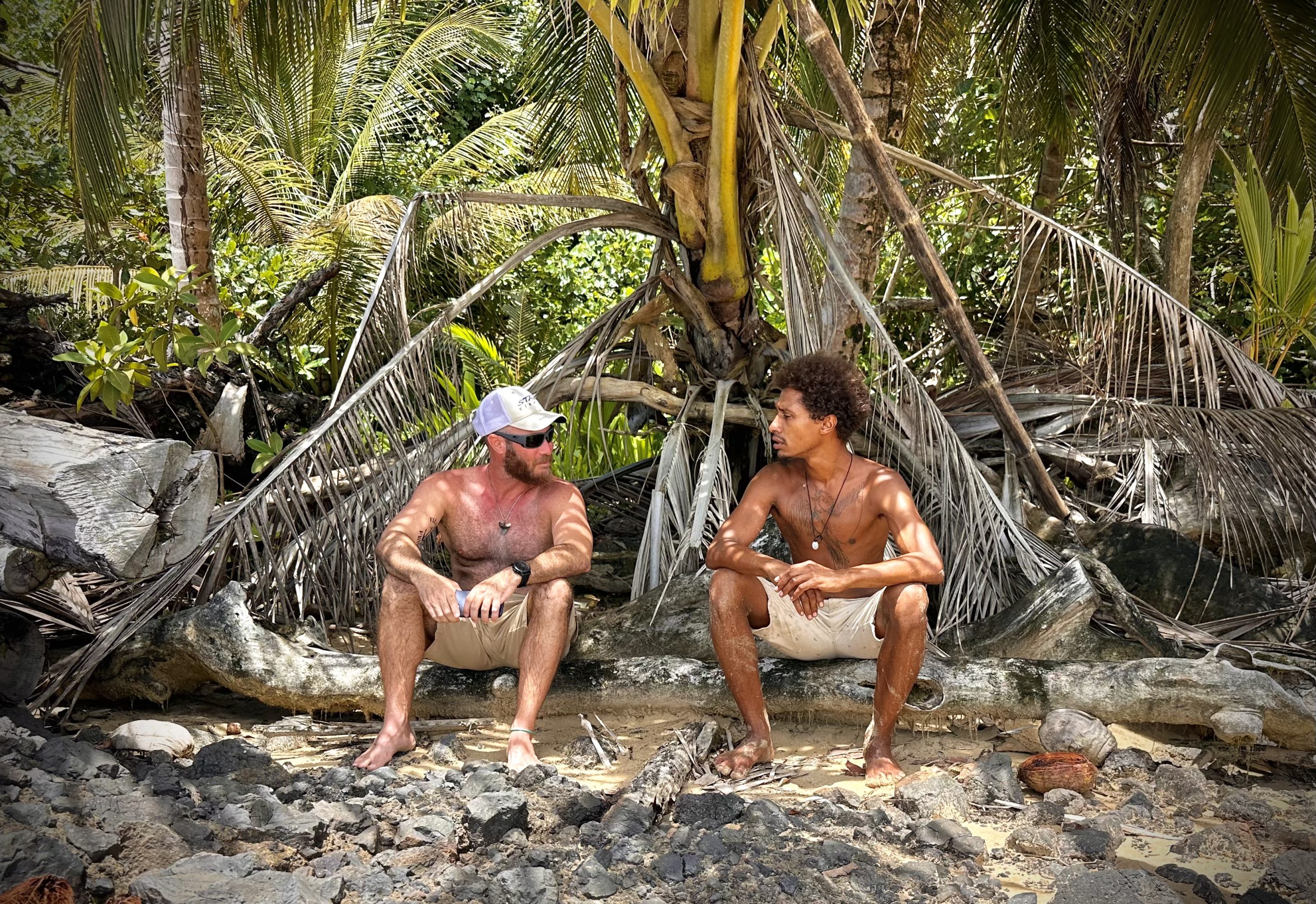
Somewhere down the beach, my travel companion was photographing the surreal sweep of the coastline.

At some point he turned his camera on us — two figures on a log at the seam of jungle and sea, sitting like old friends who had crossed a celestial eternity to convene for a few minutes. I have seen the photograph since. We look like we are discussing the tide. In a way, we were.
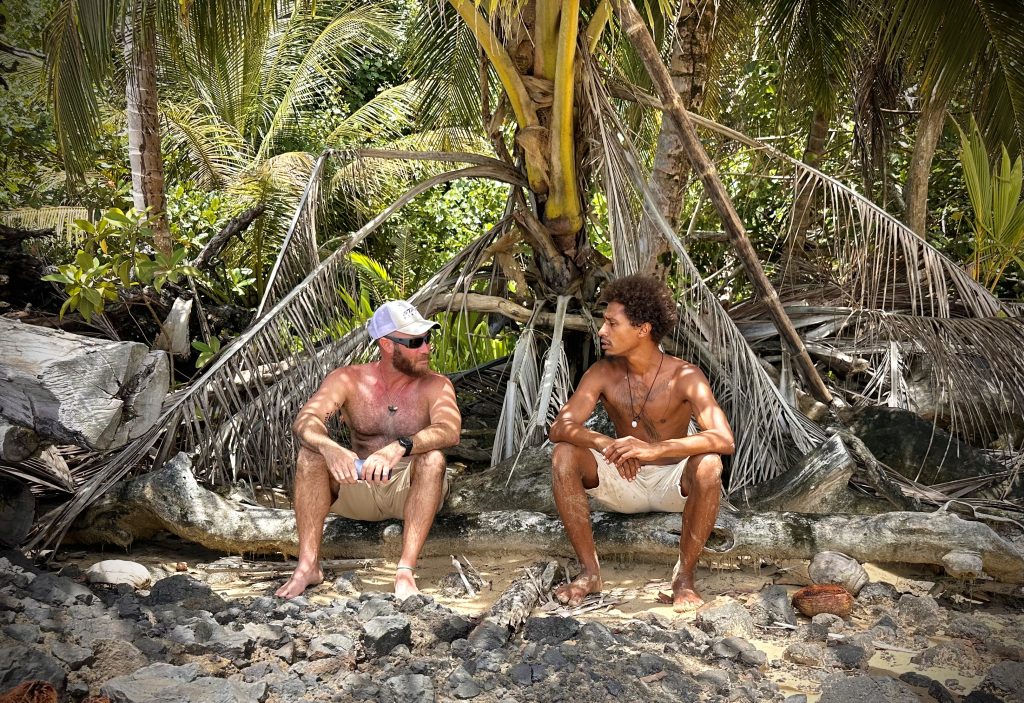
The truth is I cannot tell you how long we sat there. The song of the surf, the wind sifting through the palm fronds, the low music of his voice — together they made a chorus that silenced the pain I was carrying just long enough for me to feel something I had not felt in a year: peace. Not resolution. Not answers. Just peace, the small kind, the kind that fits inside a single morning. And that was all I could have asked for.
The conversation ended the way sacred things often do — interrupted by joy. A small black and tan dog burst from the jungle carrying a coconut nearly the size of his own head, trotted straight to us, and dropped it at my feet like an offering. Then he hopped and spun in the sand, telling his master, in the universal language of dogs, that the world was large and waiting and it was time to go.
The shaman stood, unhurried even now, and shook my hand. And then he did the thing I still turn over on quiet mornings: he thanked me — and meant it. As if I had given him something. It took me years to understand that maybe I had. That to hand someone your unguarded pain is a kind of gift; that a witness needs someone willing to be seen.
He walked back the way he came, down the long tideline, the little dog orbiting his heels, until the haze where the surf met the sand took them both — fading not like a man leaving a beach, but like a wave returning to the sea that made it.
It has been a few years now since I sat on that log wondering what comes next. What came next came anyway, as it always does — some of it worse than I feared, some of it better than I could have invented. The grief is no longer a flood; it is a tide, and I have learned its schedule. The technology that unmade my work went on remaking the world, indifferent to my permission, and I went on too. I am still not sure who I am when everything else goes. But I have stopped being disturbed by the question.
This morning I am sitting at another edge of the same sea — a windy morning in Islamorada, the palms bent and hissing, the water running green over the flats toward that same patient horizon. It is the same Caribbean, when you follow it far enough south. The same waves, still keeping the heartbeat.
And I catch myself wondering what the shaman would say to me now. But that’s not quite honest. I know what he would say. He would sit down beside me as if we had planned it a lifetime ago, look out at the water for a while, and ask:
“¿Qué te preocupa?”
I would have to think about it…