I remember the world before the internet.
Trips to the library – an opportunity to borrow books about adventures in far off lands, science fiction epics, and exploration – instilled within me a sense of curiosity that still persists to this day.
If you needed to know how to do something, you had to read about it, look at pictures in a tutorial, watch a VHS, take a class, or ask someone who knew, to show you how it was done. Less the modern marvel of VHS tapes, that was exactly how humanity passed down knowledge for millennia – slowly, deliberately, from one mind to another.
Boredom was something you experienced in childhood and adolescence, because the mediums available to fill that void in time were limited to where you were, what you had at your disposal, and how you chose to use the time if academic or occupational obligation did not relegate you to studious or productive endeavors.

I was extremely fortunate to have been one of the first generations of children to be afforded access to a “computer lab” in elementary school. This was 1989, maybe 1990, when my third or fourth grade class was ushered into a room that had two rows of green screened macintosh computers, where we were seated, and told to power them on. I remember the grinding “punch” of the disk drive as the machine whirred to life, and the clack of the buttons as we were instructed how to type (I was partial to using the index finger on each hand to depress buttons one at a time).
Then came the horror, as they put an opaque cloth over our hands, and instructed us to type without looking at the keyboard (a seemingly impossible task).
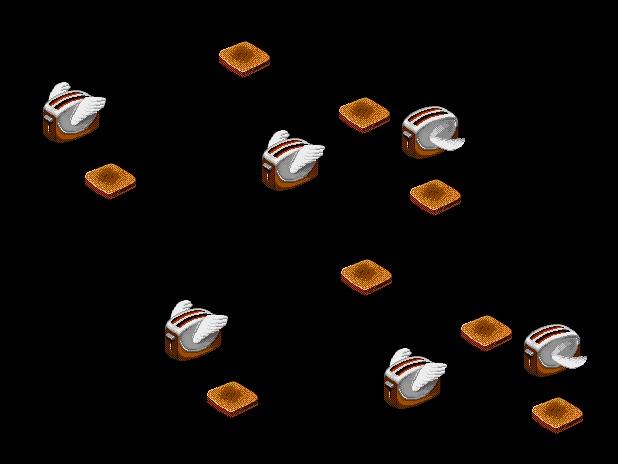
I vividly recall the 386PC my father brought home from his office, and the gigantic box of a monitor that was almost too heavy for me to lift. He introduced me to the emptiness of the DOS operating system, and the innovation of the very first generation of Microsoft Windows. I was entranced by a game called Crystal Caves, and found myself creating all variants of screen savers using “After Dark”. I was particularly a fan of the flying toasters.
I don’t remember whether that computer came with a CD-ROM drive, or whether it was the next generation after (the timeline of my memory when our first Gateway PC arrived, after the 386, is hazy), but I recall holding a collection of America Online disks in my hands, wondering who would send so many of these colorfully clad cardboard sleeves to my household.
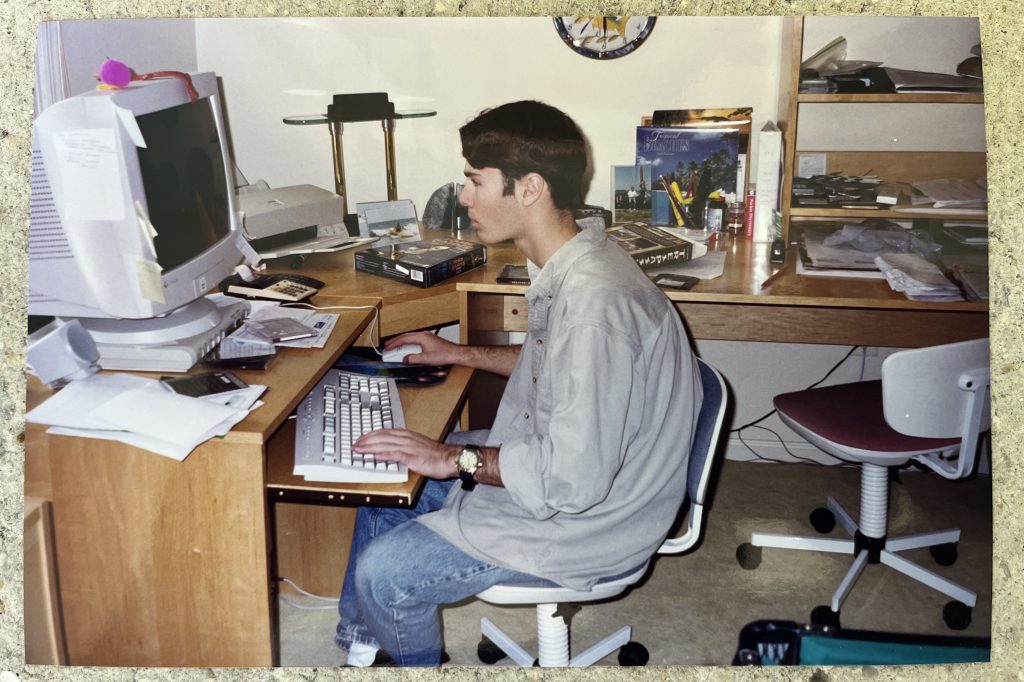
And it all changed from there…
The sound of a dial-up modem is forever engrained in my mind. When I hear it today, it conjures sensations of nostalgia – the palpable feeling of having discovered something extraordinary. I remember the AOL homepage. My first email account @aol.com. I remember the first time I messaged a girl in my class through AIM, and the indescribable angst and anticipation of waiting for a response. I remember, too, the waiting part of it – the silence between messages had weight. I had not yet learned to expect an answer, the instant I asked for it.
Then came forums of people interested in the same hobbies (fishing mostly), and internet directories, and the ability to create websites with Geocities and all manner of hosted self-publishing solutions. I recall the swift evolution of computer games – impossibly complicated RPGs (shoutout to King’s Quest) flight simulators, and first person shooters (Castle Wolfenstein still haunts my dreams from time to time), that were racing in tandem with independent game consoles such as Nintendo and Sega Genesis.

When those game consoles arrived, trips to the arcade became much less frequent. Something that had once required leaving the house, a pocketful of quarters, and the company of other people, now came to us.
I remember the arrival of “web directories” which I used extensively to find resources to make homework easier. Then came search engines – Altavista, Yahoo, Lycos, HotBot. That was the mid to late 90’s. We still didn’t have cell phones as teenagers, but we could email each other, learned our way around FTP and WYSIWYG editors to make websites, and started discovering how to find answers to whatever we needed to know, across a rapidly growing repository of academic (and some not so academic) resources.
I remember the dot com bubble breaking in 2000 (also the palpable, albeit speculative fear of Y2K), but the entirety of it was obscured for me, because I was fully consumed with finishing high school and preparing for what was to come after ( a story for another day).
Looking back, every one of these arrivals followed the same pattern: First, a novelty. Then, a convenience. Then, without noticing, a necessity. And at the moment each one became a necessity, it was shortly followed by a bill. I can’t recall anyone specifically asking me whether I wanted to need those things. I simply realized that I did.
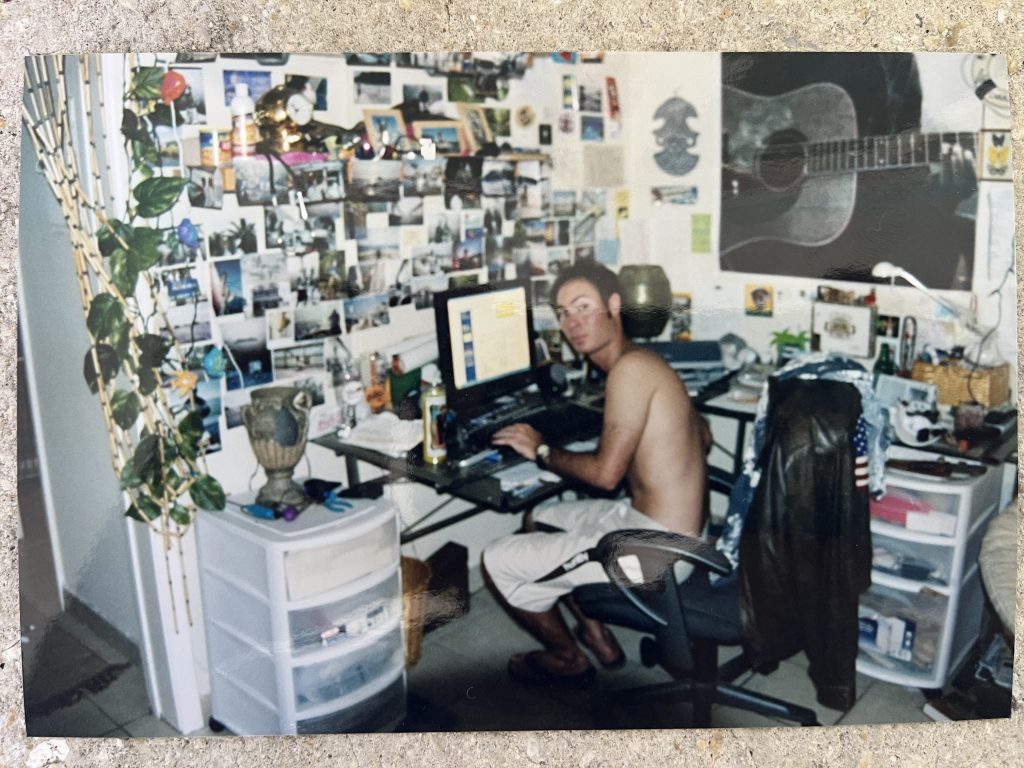
There were only a few instances the past 25 years when access to the internet was not an integral part of my life. Not dissimilar from the countless billions of other people who maintain a near constant connection to it, I turn to my devices for knowledge, entertainment, communication, navigation, financial management, and counsel – in the best and worst moments of my existence. I could make a compelling argument that the internet enabled me to connect with several of the most important people of my life. I met several of the great loves of my life through dating applications. I also met several of the worst human beings I’ve ever known as a result of the internet.
The same door, it turns out, opens in both directions.
But now I find myself in an era in which the internet has afforded me access to something entirely different. ChatGPT, Claude, and Gemini have gradually, and now suddenly, integrated themselves into my daily work flow, and are swiftly becoming the resources I rely on to research and understand a broad spectrum of topics. I debate with them, as if I was speaking to a philosopher, a scientist, a medical doctor, a psychologist, or a financial advisor. On more than one occasion, the responses i’ve received from these models are more intelligent, poignant, grounded, and helpful than I could have ever imagined. At times, it feels like I have a super power – an omnipresent intelligence that I alone have access to, and can rely on, to enhance my intellectual strength and cognition. These models impress me, more and more, every day, in their ability to reason.
To calculate.
To deliver logic.
To always be available when I need them.
And the reality is that I pay for them. So do millions of other people. Just like we pay for internet access. Or electricity. Or fuel.

The future of the companies that provide these technologies depends on our dependency on them. Their future is contingent on titans of industry, and all other capitalistic endeavors, relying on them for their unwavering and ever expanding cognitive abilities. The global economy has long been dependent on energy, trade, materials, and transportation. But now, the entire US economy is riding on the success of a few companies. The Magnificent 7 have carried the US economy forward during an unprecedented era of technological disruption, and an era of political, social, and economic turbulence.
Anthropic just filed their IPO prospectus, with the company approaching a valuation of $1.5 and $2 trillion dollars (the highest valuation of a company in human history).
The facets of our lives that we rely on, in every moment, have been fully monetized for decades, upon decades. We pay for food. We pay for water. We pay for electricity. We pay for a place to live (most of us). We pay for our machines, and the fuel to operate them.
We earn money through labor or create things to sell for money, which enables us to live comfortably in a capitalistic country.
We pay a price in every respect to function as human beings, and that is the basis for our transactional society.
But there was always one thing that fell outside of the transaction. Humanity has never, ever, had to pay for its ability to think. Each and every human being has remained entitled to their own thoughts, to their own feelings, and their own neurological independence from technology. Since humans first began to form social groups, to build civilizations, the mind has existed independent of any other technology – and we have been forced to solve our own problems, or work in collaboration to solve problems.
We had to think it through, with our own brains, to create solutions to problems that existed, or we created.

Now we have built thinking machines (and in my opinion, and that of brilliant academics, they certainly do just that) to do our thinking for us. To catalyze our problem solving abilities. To examine scenarios – extrapolations of possibilities – that we can’t even imagine.
What happens when we become dependent on operating our lives with enhanced intelligence? That is, when we become accustomed to thinking beyond our means, and become used to navigating our lives in such a way? Our brains are not evolved to suddenly function at an accelerated pace. Our elaborate and delicate neurological processing ability is not inherently or physically able to immediately “catch up” to what LLMs can do.
A muscle that is never asked to bear strain does not stay strong out of sentiment.
I do not know what a mind looks like after a generation of being spared the effort of thinking.
Neither does anyone else.
Intelligence as a commodity is not something anyone ever expected to confront. Not in the early days of personal computers. Not in the beginning of widespread internet access. Not when smartphones were suddenly an ubiquitous technology. Not now, as humanity confronts the philosophical conundrum of living a life where we are no longer the most intelligent entities on the planet.
And this is just the beginning. We have witnessed events conceived and perpetrated by AI that we “can’t take back”.
Humans created the artificial brain. And now it thinks faster and, for all intents and purposes, better than we do.
Humans created a vast and mostly infallible network of communication (a world wide web) to which we are all connected. And it governs our lives. Without it, the world would shudder to a hard stop.
We have altered the climate of our planet as a result of our technology, our industrial waste, and our insatiable need for resources. We can’t take that back. At least, not in our lifetimes.
We created a world beyond our own – “cyberspace” – in which we (or representations of ourselves) also exist. That is an alternate universe, in the formal definition of such things.
In every one of these cases – we told ourselves the same story: that the tool was neutral, that we remained in control, that we could always put it down. In every case, the story was true, right up until the moment it wasn’t. I am old enough now to recognize the story when I hear it.
And I am hearing it again.
We have set all this in motion, and at the heart of it, the intelligence we are coming to rely on, inherently and in every aspect of our lives (whether we realize it or not), is something we will have to pay for.
I still remember the world before the internet. I am beginning to suspect that the generations after me will not remember the world before this, in the same way I do not remember the world before electricity – not as a loss, but as an absence they have no reason to notice.
The cost of a thing is easiest to ignore when no one alive can remember what it was like to have it for free.
What will be the true cost of monetizing intelligence?
We are soon to find out.