This is an era of unprecedented social problems, economic challenges, technological disruptions, and philosophical dynamics that humanity is struggling to navigate. And with that comes the spectacle of individualized confrontations with existential considerations whose anthropological repercussions will be felt for generations.
This is an extraordinary time to be alive. The world is changing, tangibly, in every way imaginable. Reality itself, as we perceive it through our distinctive lens of consciousness, is influenced by intentionally orchestrated distortions conceived by few, then disseminated to the masses via algorithmically controlled mechanisms designed to cascade imagery, sounds, and language to those who voluntarily receive them with great willingness. The stoics would have recognized the danger at once. Epictetus taught that we are disturbed not by things, but by our judgements about things – and we have now built an entire industry whose business is the manufacture of judgements, delivered faster than any human mind can examine them.
This is an astonishingly terrifying moment in human history, when the architects of our greatest conceptions such as mathematics, technology, epistemology, etymology, and transhumanism are leading us in a direction where discussion of civilizational growth or collapsology – the transdisciplinary study of the potential collapse of modern industrial civilization – is becoming more commonplace.

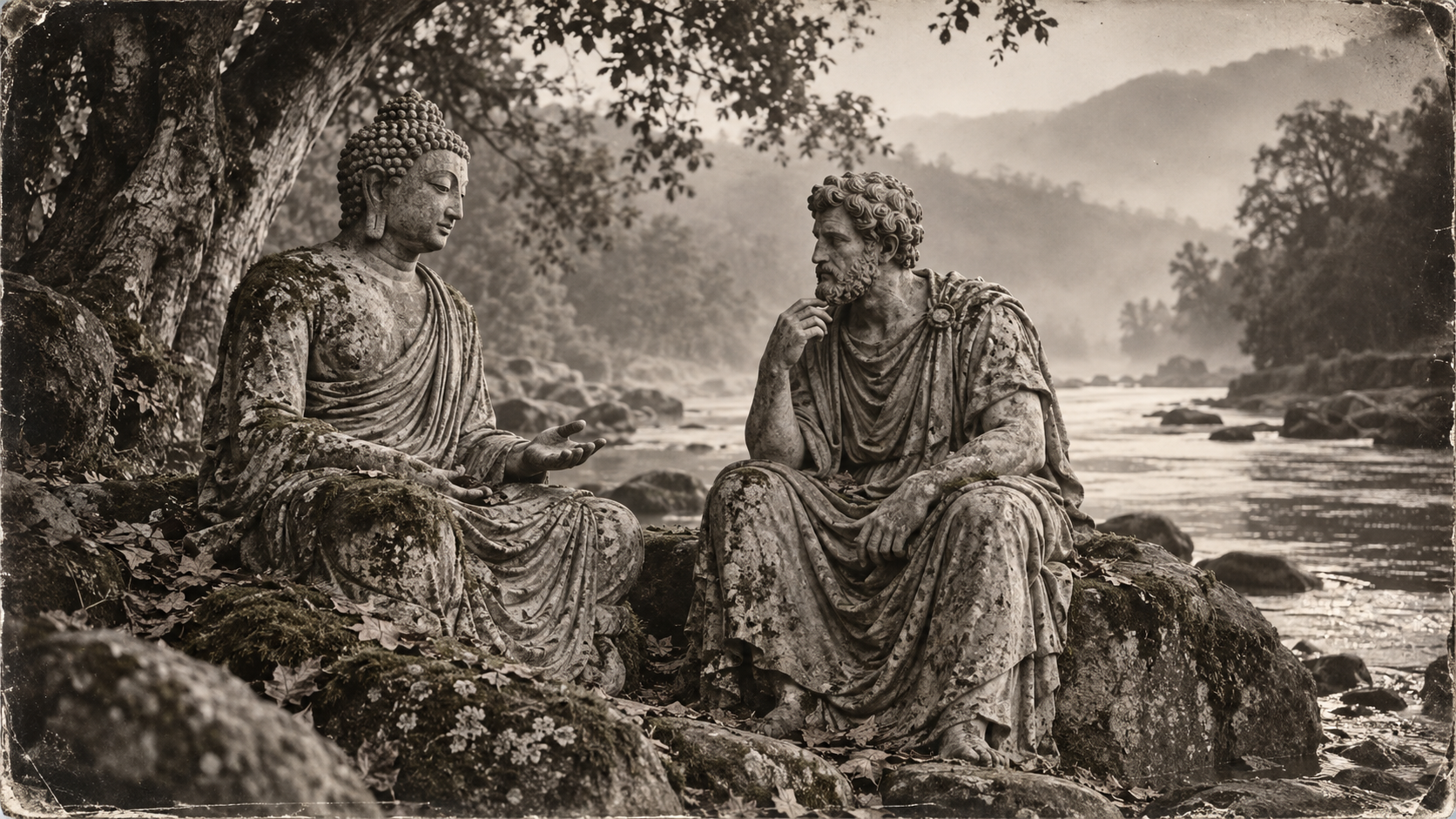
And at times – I don’t think anyone is really paying attention. Which is the quiet tragedy of it, because attention is the one faculty the ancients agreed we never cease to own. The stoics referred to this as “prosoche” – the vigilant watch kept over one’s own mind. The buddhists called it “sati” – mindfulness. Two traditions that transcend our concept of time – conceived a continent and several centuries apart – arrived at the same conclusion: an unexamined mind does not belong to you. It belongs to whoever is speaking loudest.
These pivotal moments, succinct and profound, flow freely around us like a gentle tide pulling at our feet, knowing full well they are returning to form a towering wave that will inevitably build and then fall upon us.
You need only look to our cumulative recollection of history to catch a glimpse of the junctions that came before – those words and whispers which passed down through millennia, to guide us, and protect us, from what we were, or could become.
“What we do in life…echoes in eternity…” proposed the fictional Roman General Maximus Decimus Meridius.
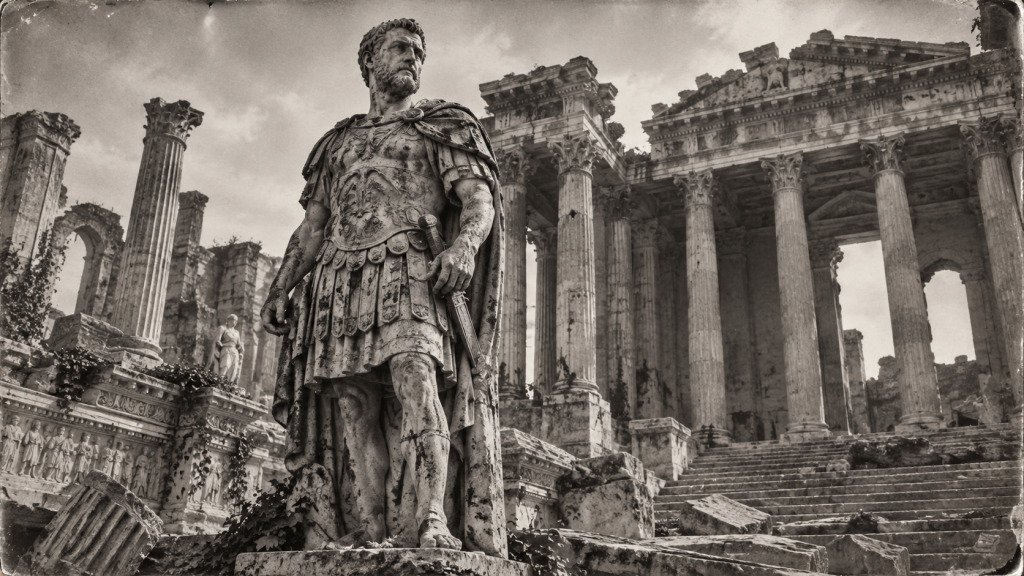
But it was Marcus Aurelius, the actual leader of Rome, a man who deeply valued ruthless focus on the present moment, acting out of a sense of duty, and the inevitability of time to consume all things that offered an irrevocably infallible lesson that purposes just the opposite…
“Constantly reflect on how swiftly all things that exist or are coming into existence are swept away and disappear… Think of the whole of time, of which a brief and fleeting moment is assigned to us.” — Meditations, Book 5.23
I’m not alone in my frustration, but I am alone in the particular guilt of knowing how much time i’ve surrendered to that frustration…that anger…with circumstances well beyond my control. And how foolish am I, in my ephemeral existence, to harbor resentment towards what I don’t have in this life. What is beyond my means to own, or understand, or control.
Epictetus opens the Enchiridion with the only division that ultimately matters: some things are within our power, and others are not. Nearly everything I have ever envied lives in the second category. Nearly everything I have neglected lives in the first.
Feeling jealous or envious of someone else’s success is one of the most exhausting modern stresses. Whether it is instigated by a coworker’s promotion, a friend buying a home, or someone’s curated highlight reel on social media, envy tricks us into feeling like we are falling behind – behind in a race whose finish line has never been located, measured against a field of competitors who are themselves glancing over their shoulders at someone else.
Marcus Aurelius knew these feelings intimately. His meditations were never written for us. They were the private ledger of a man arguing with his own appetites – for reputation, for the verdict of posterity, for the esteem of men he suspected were wiser than he. Here was inarguably one of the most consequential human beings to have ever lived…a stoic philosopher whose words still reverberate in the principles of the elite as they actively guide humanity into its next era…or demise…and he needed to remind himself, in writing, night after night, that the applause of other people is worth nothing. He confronted the same feelings I am navigating over candlelight, as I write this on my machine made of glass, metal, plastic, and electricity.
How can we dismantle the human experience of such feelings as jealousy or envy into something meaningful?
The Concept of Time As An All Consuming River

Time is a river, a fierce torrent of things that come into being; no sooner is a thing brought to sight than it is swept away and another takes its place, and this too will be swept away.” — Meditations, Book 4.43
Time is not an ally to mankind. But it is the very notion of impermanence that can deliver an extraordinary reprieve from the burden of carrying the existential weight of inadequacy, resentment, and envy. The stoics saw the river clearly. It was the buddhists, half a milenium earlier, and half a world away, who taught us how to stand in it. Let us shift from Roman Stoicism to Buddhism…
In Buddhism, Anicca teaches that absolutely everything in the conditioned world – from a galaxy to a thought, to a bank account – is in a constant state of flux. It arises, changes, and passes away. Envy happens because our minds try to grasp onto things that are fundamentally ungraspable, treating fleeting states of success as permanent fixtures. It is a fallacy dressed up as an emotion.
In Buddhism, impermanence is the first mark of existence, accompanied by dukkha (suffering caused by attachment to the unstable) and anatta (the absence of a permanent, independent self). The third mark is the most radical, and the most liberating: if there is no fixed, permanent self, then there is no fixed permanent self to be falling behind. The “I” that measures itself against another is itself a passing arrangement of conditions. A weather pattern mistaking itself for the sky.
Wealth and career status are highly volatile, dependent on an infinite web of changing conditions (the economy, corporate priorities, technological disruptions, and physical health). A title is not a permanent attribute of a person; it is a temporary role they are playing. Marcus Aurelius, who played the most elevated role on earth, practiced seeing through such costumes. The “imperial purple”, he reminded himself, was simply sheep’s wool dyed in the blood of an arthropod. This was not cynicism – it was clarity – the deliberate stripping away of the glamor we paint onto things, so we might see them for what they really are.
Human suffering happens when people demand permanence, control, or possession over things that are inherently unstable. The Buddha named the mechanism “tanha” – thirst. Fighting against change through craving (holding onto what is pleasant) or aversion (rejecting what is unpleasant) creates psychological friction and pain. And envy is both at once – a craving for what another has, and an aversion to the self who lacks it.

There is a buddhist teaching about two arrows. The first arrow is the event itself – the promotion given to someone else, the house we cannot afford. We rarely control the first arrow. The second arrow is the one we fire into our own wound; the rumination, the comparison, the quiet verdict that we are less. Seneca wrote much the same to his friend Lucilius – that we suffer more often in imagination than in reality.
The first arrow is pain. The second is suffering. Only one of them is optional, and it is the one we keep choosing.
That begs the question – what does it take to create, or arrive to, a state of equanimity?
The stoics called it “apatheia“. The buddhists called it “upekkha”. In neither tradition does it mean “numbness”. They both allude to a mind steady enough to hold joy and loss in the same hand.
I believe the arrival to such a place requires an acceptance of impermanence, while focusing on the moment, in pursuit of a happiness that does not depend on circumstance.
It requires a cathartic event or realization. A purgation of guilt, envy, and jealousy. An appreciation for what you hold sacrosanct in your mind, and in your heart, not in your hands.
Trying to find lasting happiness in a lifestyle is like trying to catch water in a net. The person before you which instigated those sensations of envy and jealousy, while living that luxurious lifestyle, is subject to the exact same hedonic treadmill as you; they get used to the luxury, and then they need more just to feel normal.
When you see a lavish lifestyle, realize you are just looking at a highly temporary arrangement of someone’s fortunate existence – one that will soon change. That is inevitable. That is true. And here buddhism offers something stoicism gestured toward, but never quite named: “mudita.” Sympathetic joy – the practice of taking real pleasure in another person’s good fortune. It is the exact inverse of envy, and it costs nothing, because their happiness was never subtracted from your share. There is no share.
There is only the river. And we are all standing in it.
Comparison is the thief of joy – but only because we leave the door unlocked. The thief enters through the imagination, through the second arrow, through the fiction that somewhere there is a fixed self who is losing. Lock that door and there is nothing for the thief to take.
I’m not alone in my frustration. Or my struggle to dispel the sensations of envy, jealousy, and resentment that have shadowed and tarnished my fortunate existence.
And you’re not either.