


There is a placard on a wall at the Tri-Cities Historical Museum in Grand Haven, Michigan, that tells one of those quietly devastating American business stories—the kind that feels small until you realize it is, in fact, the only kind of story there is.
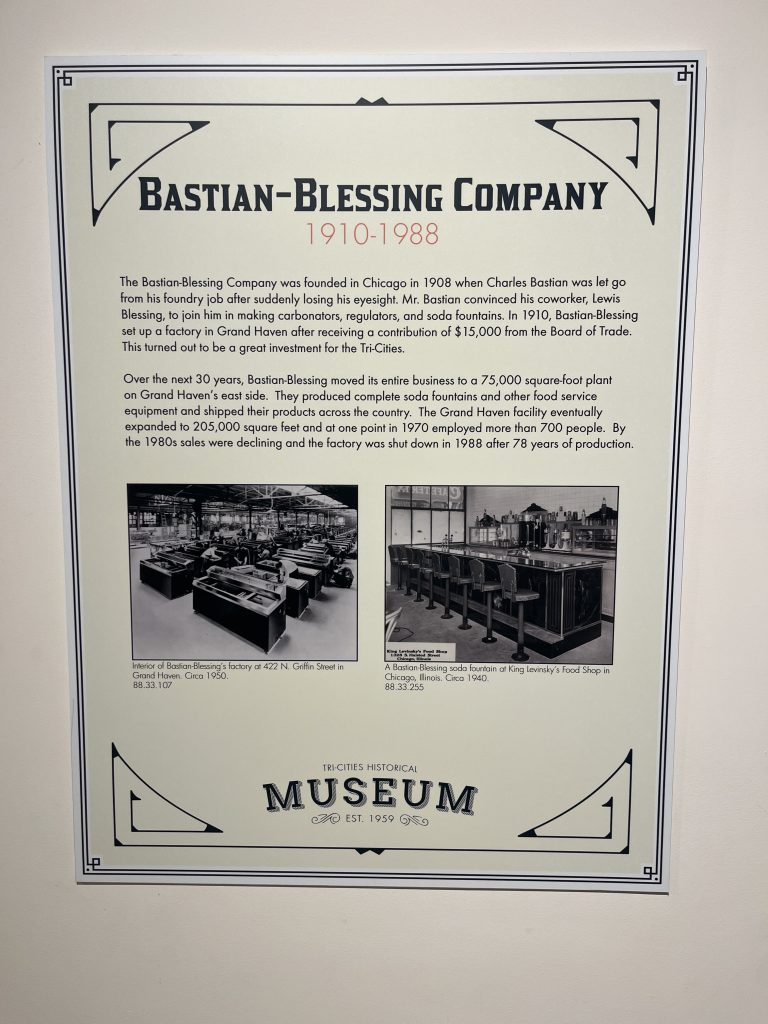
The Bastian-Blessing Company was founded in Chicago in 1908, the placard explains, under circumstances that would make a screenwriter blush. Charles Bastian was let go from his foundry job after suddenly losing his eyesight. Rather than retire into the role history usually assigns to the recently blinded and unemployed, he convinced a coworker, Lewis Blessing, to go into business with him making carbonators, regulators, and soda fountains. In 1910, after a $15,000 contribution from the Board of Trade, they set up a factory in Grand Haven. The museum, with admirable restraint, calls this “a great investment for the Tri-Cities.”
It was. Over the next thirty years, Bastian-Blessing moved its entire operation to a 75,000-square-foot plant on Grand Haven’s east side, producing complete soda fountains and food service equipment that they shipped across the country. The facility eventually swelled to 205,000 square feet. At its 1970 peak, it employed more than 700 people. And then, in the way these things always seem to happen – gradually, then all at once – sales declined through the 1980s, and the factory shut down in 1988 after seventy-eight years of production.
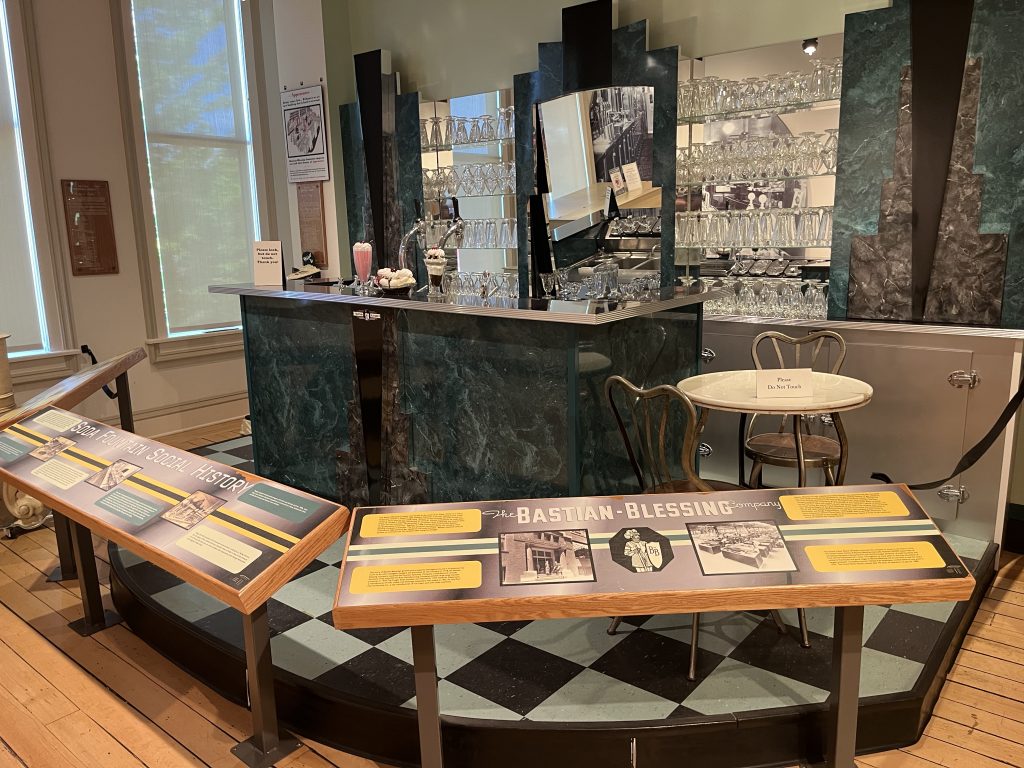
Seventy-eight years. Three generations of Grand Haven residents who could say their father, and their father’s father, made the gleaming marble-and-chrome altars at which mid-century America worshipped the malted milkshake. And then a wall placard, an immaculately restored display fountain, and a polite sign reading “Please Do Not Touch.”
I bring this up because I have worked in the SEO industry, and it’s adjacent industries (SEM, Content Marketing, Link Building) for 18 years, and I have been thinking a great deal lately about the lesson to be had from the era of soda fountains.
The Cathedral of the Carbonated
To understand why Bastian-Blessing matters, you have to understand what a soda fountain was. It was not a vending machine. It was a piece of civic infrastructure.
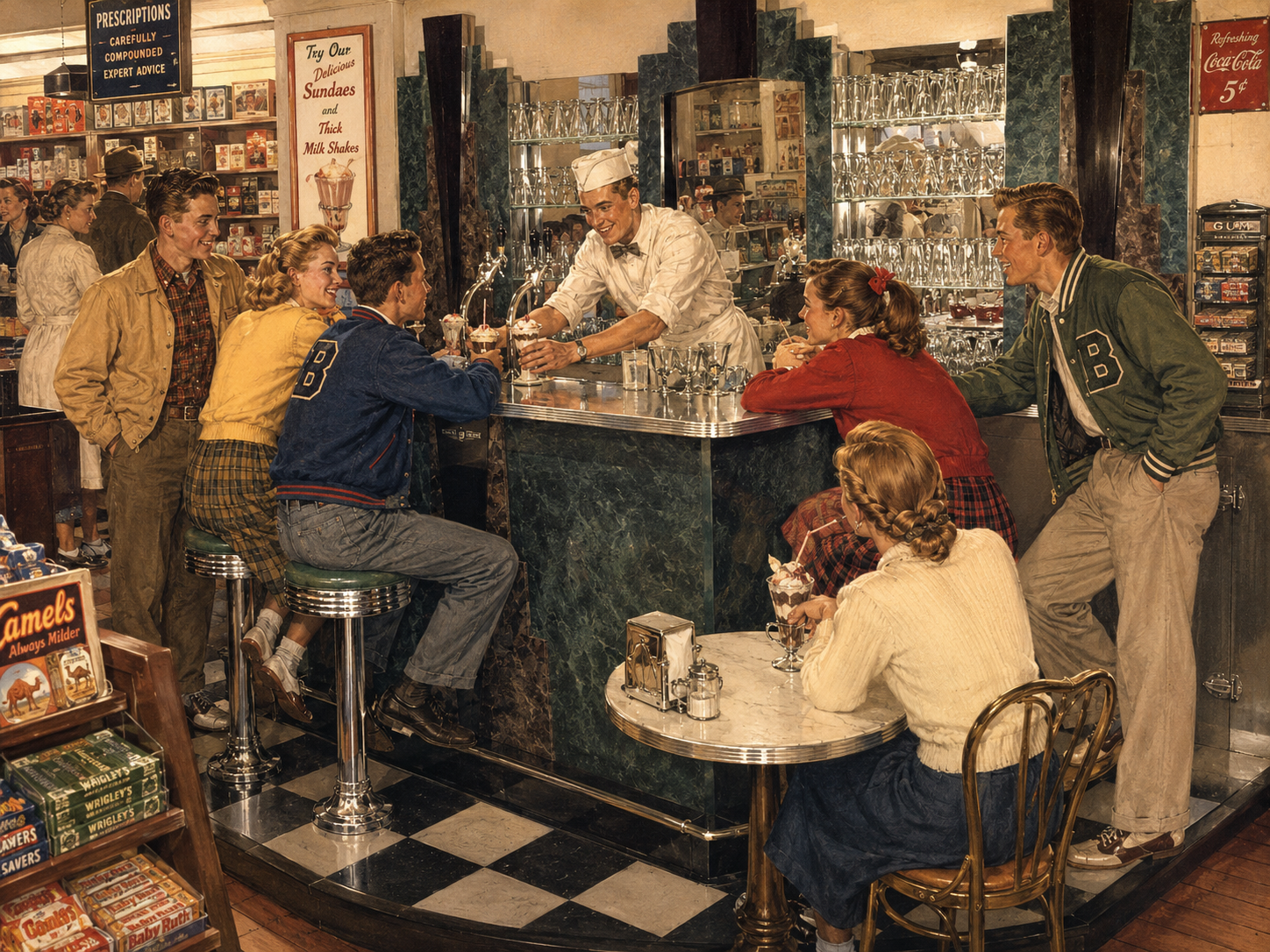
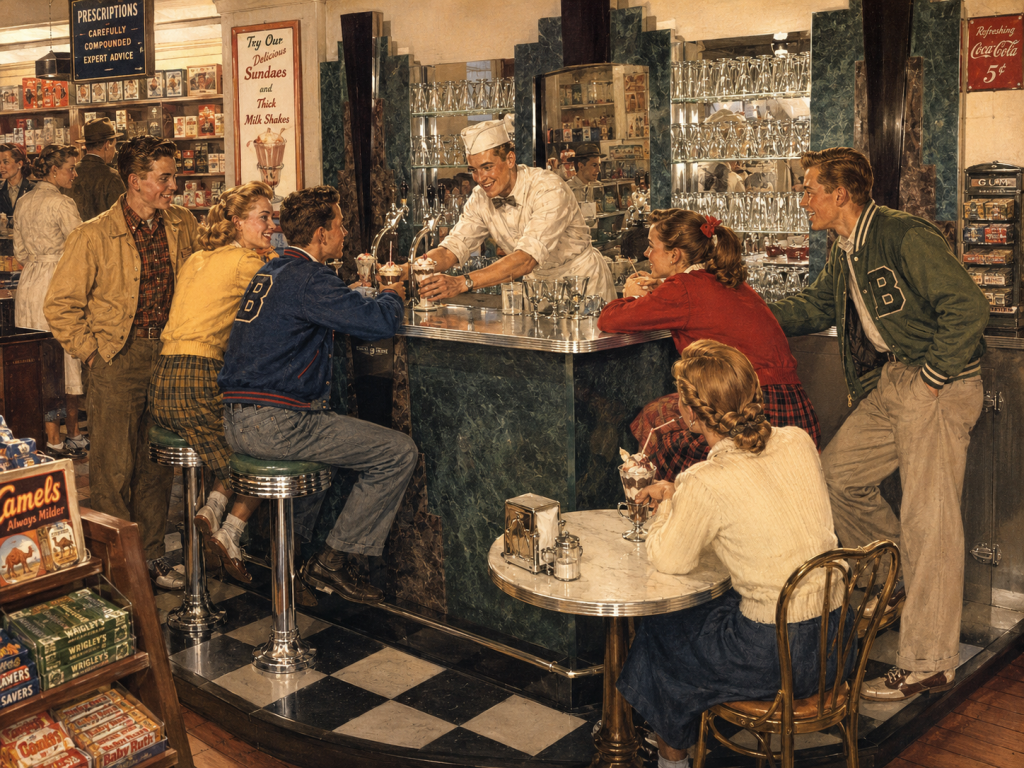
In the era of Prohibition and after, the soda fountain was where a town’s social life happened -the drugstore counter where teenagers conducted their first awkward courtships over egg creams, where businessmen took meetings, where the whole machinery of small-town American sociability hummed along on a current of sugar and seltzer.
The photograph on the museum placard of a Bastian-Blessing fountain installed at King Levinsky’s Food Shop in Chicago, circa 1940, shows you the thing in its glory: a long chromed counter, a row of stools, a backbar bristling with mixers and syrup pumps, the whole apparatus radiating the confident permanence of an institution that assumed it would always be needed.
That is the part worth sitting with. The assumption of permanence. Bastian-Blessing did not build soda fountains as a fad. They built them as furniture for a civilization that they reasonably believed would keep wanting them forever. They were extraordinarily good at it. They were good at it for the better part of a century. And being good at it turned out to be almost entirely beside the point.
Because the thing that killed the soda fountain was not a better soda fountain. No rival firm out-engineered Bastian-Blessing into oblivion. What killed it was that America stopped wanting the thing the soda fountain provided in the form the soda fountain provided it. The supermarket sold cold six-packs. The home refrigerator made the corner drugstore’s chilled marble counter redundant. McDonald’s discovered that you could sell a Coke faster, cheaper, and with less skilled labor if you simply handed it through a window.

Fast food and self-service didn’t beat the soda fountain on its own terms. They changed the terms, and the soda fountain was left manufacturing exquisite answers to a question nobody was asking anymore.
You can perhaps see where this is going.
The Search Box as Soda Fountain
For roughly twenty-five years, the SEO industry has occupied a position in the digital economy structurally identical to the one Bastian-Blessing occupied in the analog one. We built the infrastructure of an entire way of doing business. The premise – the load-bearing assumption beneath the whole enterprise – was that people who wanted things would type those wants into a box at Google, that Google would return ten blue links, and that businesses would compete, sometimes elegantly and often grotesquely, to be among those links. An entire profession arose to serve this premise: keyword research and link building and content strategy and the dark liturgical arts of the meta description.
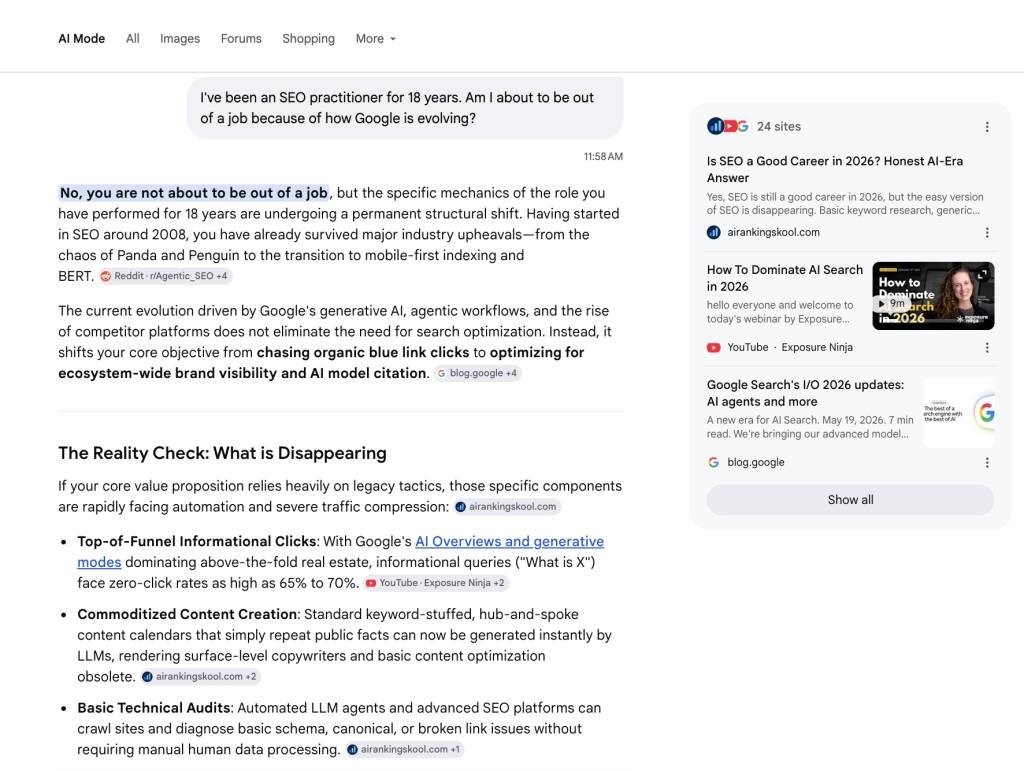
And, like the men who polished marble in Grand Haven, we were good at it. We were good at it for a long time. We assumed permanence, because the thing seemed permanent, because it had been working since before some of its current practitioners could read.
Now AI-generated answers sit atop the search results, confidently summarizing the very content they scraped to learn how to summarize, and the organic traffic that the entire SEO industry exists to capture is being throttled at the source. Why click through to ten blue links when the box simply tells you the answer—an answer assembled, with no small irony, from the labor of the very publishers it is now starving of visitors? The user got what they wanted. They just stopped wanting it in the form we spent twenty-five years learning to provide.
I do not think the parallel is perfect, and I distrust anyone selling you a parallel that is. But the shape is unmistakable. A mature, sophisticated, deeply optimized industry, supremely competent at delivering a particular thing, discovers that competence was never the variable that mattered. The variable that mattered was whether the customer still wanted that thing, that way. And that variable was never under the industry’s control. It never is.
The Comforting Lie of Disruption
Here is where the business-school version of this story usually inserts its moral, and here is where I would like to gently decline to do so.
The standard reading is that Bastian-Blessing “failed to innovate,” that SEO is being “disrupted,” and that the lesson is some bracing call to “Adapt Or Die”, preferably delivered by a man in a quarter-zip who has never personally adapted to anything more demanding than a new espresso machine. This reading is flattering because it preserves the fantasy of control. It tells you that the dead company could have lived, if only it had been smarter, faster, more visionary – and therefore that you will live, because you, naturally, are all three.
I think this is mostly a comforting lie. Some companies genuinely fumble transitions they could have made. But many – maybe most – simply provided something a moment wanted, and then the moment ended, and no amount of vision was going to convince Americans to abandon their refrigerators and return to the drugstore counter out of respect for Grand Haven’s craftsmanship.
Bastian-Blessing didn’t make a soda fountain that was insufficiently good. They made a superb product for a world that quietly dissolved beneath it.
There may have been no winning move. Sometimes the only available wisdom is to have noticed the dissolving a little earlier and to have taken the seventy-eight good years as the gift they were rather than the down payment on an eternity that was never on offer.
Cycles, Not Lines
Which brings me to the broader consideration, the one I actually want you to leave with – and it is not “everything ends,” though everything does, and it is not “adapt or die,” though sometimes you can and should.
It is that businesses and industries are not lines but cycles, and they are governed less by the cleverness of their operators than by the migrating attention and appetite of the people they serve.
Consumer demand is not a foundation. It is weather. It moves. The soda fountain rose because a particular configuration of technology, prosperity, and social ritual made a chrome counter the center of town, and it fell because that configuration recomposed itself into something that had no use for chrome counters. The same forces that lifted it set it down. There was no villain. There was only the tide, behaving exactly as tides do, indifferent to how beautifully you had built your sandcastle.
SEO is somewhere along that same arc. So, for that matter, is whatever AI tool is currently being sold to you as the permanent replacement – and I would invite the architects of the new order to note, with whatever humility they can locate, that they are not the end of the cycle. They are merely its current crest. The technology that strangles organic search this decade will itself be the soda fountain of some later one, lovingly preserved behind a “Please Do Not Touch” sign while a profession that hasn’t been invented yet looks on and thinks, how could they not have seen it coming?
The honest posture, then, is neither panic nor the manic optimism of the disruptors. It is something closer to what that museum placard models so well: a clear-eyed gratitude for the thing while it lasted, an accurate accounting of what it was and what it did, and a refusal to pretend that its ending was either a tragedy or a failure rather than simply the back half of a cycle that the front half always implied.
Bastian-Blessing made soda fountains for seventy-eight years and shipped them across a country that loved them, and then it didn’t, and now there is a placard. That is not a cautionary tale about insufficient innovation. It is a cautionary tale about mistaking the crest of a wave for solid ground—a mistake the SEO industry made, that AI is now making, and that you, reading this, are almost certainly making about something right now.
The wise move is not to never build on the wave. You have to build somewhere, and the crest is where the view is best. The wise move is simply to remember, while you are up there enjoying it, that it is a wave. Build well. Take the good years. And when the water moves—because it will move—try to be the kind of operation that gets a tasteful museum placard rather than the kind that insists, all the way down, that this time the tide was supposed to stay.