


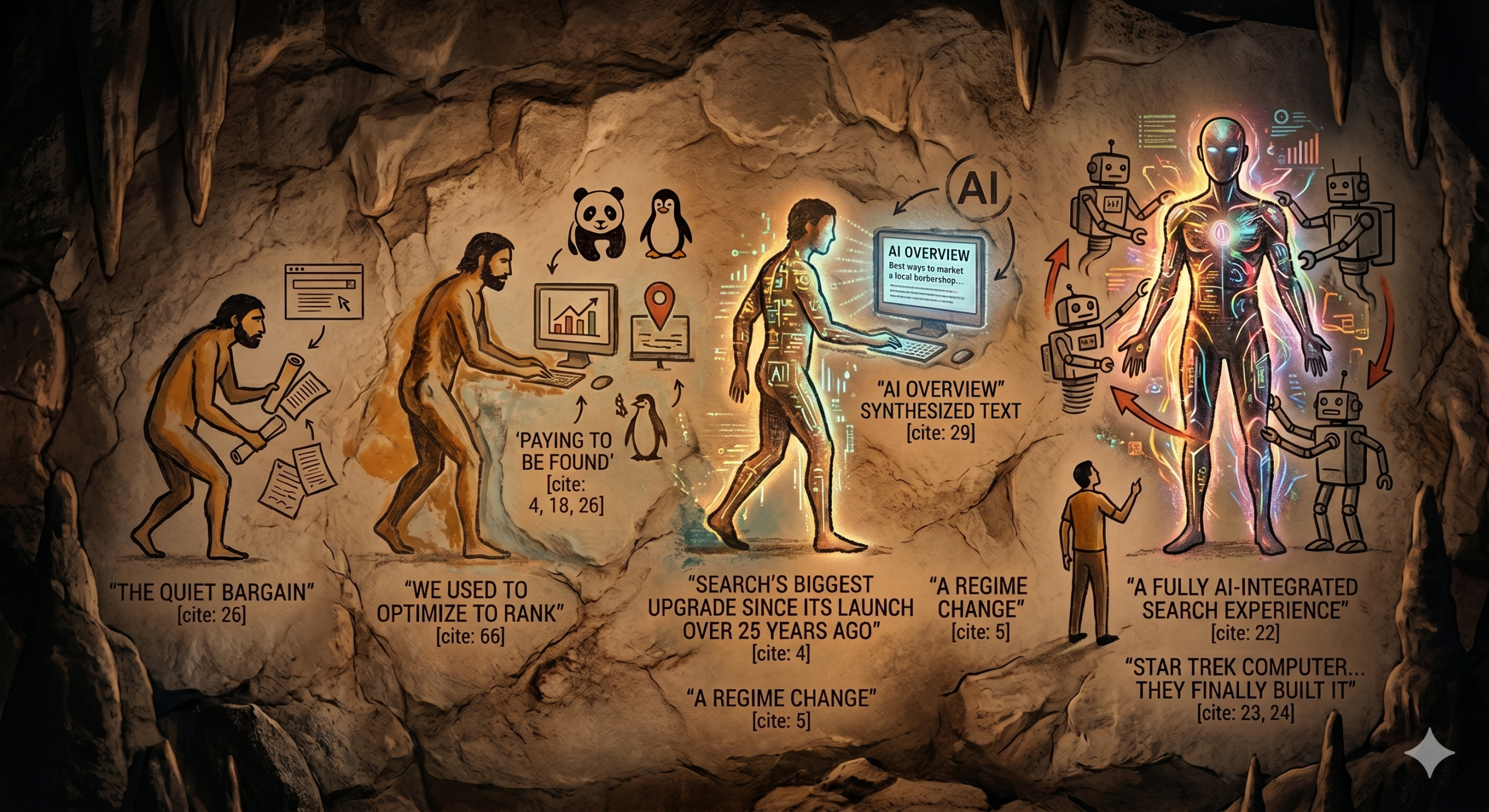
If there was ever a day to commence the era of Generative Engine Optimization - it was Google's I/O on May 19th.
I’ll admit it: this is a difficult article for me to write. Not because I don’t have anything to say, but because I have too much, and most of it is tangled up in mixed emotions about what yesterday’s announcement means for the future of the search marketing industry — and, more pointedly, what it means for people like me, who have spent the last 16 to 20 years studying and practicing SEO and internet marketing.
When Google’s own head of Search calls AI Mode “Search’s biggest upgrade since its launch over 25 years ago,” and then makes it the default experience, that’s not a feature release. That’s a regime change. Google didn’t tweak the front door to the internet yesterday. It rebuilt it.
Let me be clear: I’m no stranger to transition — far from it.
I remember processing raw server logs for traffic data, and the migration to Urchin analytics, then Google Analytics. I remember discovering SEOmoz.org and realizing there was an emerging community of “SEOs” applying all manner of strategies to grab #1 positions they had no business holding. I remember WebmasterWorld, the PubCons’, the Search Engine Strategies conferences, and a curious cast of characters (Jim, Aaron, Rand) whose writing first enlightened me to the possibility of doing this full time.
I remember the Google Ads interface in 2008. Messing around with the earliest versions of WordPress. When Twitter debuted and nobody knew what the hell to do with it — I’d argue most people still don’t. I remember the zoo animals Google deployed to combat spam: Panda and Penguin most notably. I remember reading Bill Slawski’s patent breakdowns and feeling genuine awe at how fast the technology Google was building came to light. I remember when Michael Gray, Aaron Wall, and a handful of other search personalities argued publicly with Matt Cutts. I remember when the “(not provided)” protocol quietly took our keyword data out of analytics. When Google Trends arrived. The slow-motion debacle of Google+. When Bing appeared out of nowhere and nobody cared — and still, nobody cares. I remember when Google Webmaster Tools became Search Console. I won’t even start on the evolution of Google Maps and the local ecosystem, and I don’t dare open the wound that is GA4 compared to UA.
Sixteen, seventeen years of this. I’ve seen so much change, and I’ve adapted to whatever Google did — every algorithm update, every interface overhaul, every data stream they giveth and taketh away — in order to keep my business growing and to help clients around the world leverage Google for organic traffic.
And now?
Now I honestly feel more disheartened than anything else.
The thing I can’t stop thinking about
I am genuinely fascinated by the transition to a fully AI-integrated search experience that will, eventually, give people the information and support they need to do — pretty much anything. That part is wondrous. It really is the “Star Trek computer” Google’s founders said they were building from the very beginning. They finally built it.
But I also realize that website traffic is going to collapse.
Here is the part that bothers me existentially. For 25 years, search worked on a quiet bargain: you publish something useful, Google sends you a visitor, and that visit is the unit of value the entire industry is built on. Everything we do — keyword research, content strategy, technical SEO, link earning, conversion optimization — exists to win and convert that click. The click is the currency. It’s how we prove we did anything at all.
AI Mode breaks the bargain. When the answer is synthesized and delivered inside the search experience itself, the user gets what they came for and never leaves. Google’s own numbers tell the story: AI Mode crossed a billion monthly users in roughly a year, with queries reportedly more than doubling every quarter. People aren’t searching less. They’re searching more — and clicking through less. The era of doing your own discovery, of following a link to a source and forming your own judgment, is quietly ending.
And the systems of measurement we used to prove our efficacy are going with it. I struggle to even imagine what the new measurement frameworks will look like — whether they’ll be tangible, whether they’ll be reliable, whether “we earned a citation in an AI answer that drove no click but influenced a decision” is something anyone can actually quantify or bill against. We are about to be asked to prove value in a medium that was specifically designed to remove the click we used to count.
Yes, Google has kept a “Web” tab where the old blue links still live, for the people who want them. I’m grateful it exists. But let’s be honest about what a tab buried behind the default really is. It’s a museum. The exhibit is still open; almost no one walks in.
The era where you pay to be found
This is the part of the announcement that should concern every business owner, and it’s the part Google was most careful not to dwell on yesterday: if organic discovery collapses, how do you get found?
I think we already know the answer, because Google has been quietly building it in plain sight. Over the past year, ads have been creeping into AI Overviews — by some analyses appearing at the bottom of roughly a quarter of AI Overview results, up from low single digits a year earlier. That’s not gradual. That’s a land grab. Reporting suggests Google is deliberately monetizing AI answers “lightly” at first — enough to establish the inventory and grind down competitors in the LLM-conversation space, with the dial ready to turn up whenever they choose. The ad-serving infrastructure for AI Mode reportedly already runs in parallel with answer generation, returning empty slots today, fully operational and waiting.
Then there’s Direct Offers — Google’s pilot format that surfaces a tailored deal to a shopper inside the conversation at the exact moment intent peaks. Google’s own framing is telling: they say they aren’t just bringing ads to AI, they’re “reinventing what an ad is.” Read that again. The ad is no longer a box above the results. The ad becomes part of the answer.
Here is the uncomfortable logic, followed to its conclusion. If the AI answer is the destination, and the AI answer can be monetized, then the most reliable way to appear in front of a buyer is to pay to be inserted into the response.
Organic visibility doesn’t vanish — but it becomes the thing you can’t fully control, while paid placement becomes the thing you can.
For a generation of marketers who built careers on the idea that you could earn your way to the top with better content and smarter structure, that’s a hard pill. The center of gravity shifts from earning attention to purchasing presence.
And I don’t think that’s a good thing — at least not for the small business owner who once relied on Google as their principal, free point of discovery. The barbershop, the regional law firm, the independent e-commerce brand, the local plumber: these are businesses that competed on relevance and reputation, not on the size of their media budget. In a world where being in the answer increasingly means bidding for the answer, the playing field tilts hard toward whoever can spend. The open web rewarded the resourceful. A pay-to-be-found web rewards the well-funded.
So what does the practical shift look like? I think paid strategy stops being a parallel channel and becomes the load-bearing wall.
Smart bidding, broad match, and the newer AI-driven campaign types (AI Max for Search, Performance Max) become less optional, because those are the campaign structures Google has signaled are eligible to surface inside AI experiences. Product feeds have to be clean, structured, and semantically aligned not just to the query but to the generated answer. And because fewer people will arrive on your site overall — but the ones who do will be further down the decision path — budget logically flows toward the bottom of the funnel: retargeting, high-intent landing pages, and offers engineered to close rather than to introduce. Fewer visitors, more qualified, more expensive. That’s the trade.
Writing for machines that write for machines
If this is the era of Generative Engine Optimization, then the foundation of SEO doesn’t disappear — it mutates. There will still be a need to optimize content for inclusion and citation in AI answers, whether the surface is Google’s AI Mode or whatever ChatGPT and Claude become next. The platforms still have to draw on information that exists “out on the web.” The question is what kind of information earns its way in.
The mental shift is this: we used to optimize to rank for a query. Now we optimize to be selected as an input into an answer. Those are not the same job. Ranking was about being the best single destination for a click. Selection is about being the most quotable, the most verifiable, the most cleanly machine-readable source that an LLM can confidently synthesize and attribute.
You’re no longer competing for a position on a page. You’re competing to be the sentence the model decides to trust.
In practice, I think that pushes us toward a few things that, frankly, good marketers should have been doing anyway. Visibility moves from pages to entities — your brand, your products, your people, your locations — and those entities need consistent, corroborated signals across the whole web, because the model synthesizes across sources rather than crowning one URL. It rewards content that states things plainly and defensibly: clear claims, real data, original research, structured information a machine can lift without ambiguity. It rewards being unmistakably who you say you are everywhere you appear.
But here’s the existential knot I genuinely can’t untie, and I’ll lay it out honestly because pretending I have it solved would be a lie.
If the winning move is to publish content optimized for machine consumption, and increasingly that content is itself produced with AI assistance, then we are drifting toward a strange recursion:
LLMs producing content for LLMs, so that LLMs can serve it to other LLMs doing research on behalf of humans.
At what point does the human — the actual person whose attention and trust started this whole economy — drop out of the loop entirely? At what point does the open web stop being a record of human knowledge and become a synthetic feedstock that exists only to train and feed the machines summarizing it?
I don’t know. And I want to be clear: no one else does either. Anyone selling you certainty about how this resolves is selling you something.
What I actually believe, underneath the dread
So let me try to land this somewhere other than despair, because I don’t think despair is warranted, even on a day when it’s tempting.
People will still turn to Google — perhaps more than ever — to get the information they need. That demand isn’t shrinking; it’s exploding. The intent is still there. The buyers are still there. What’s changing is the shape of the moment in which they decide, and the question for every business is no longer “how do I rank?” but “how do I stay relevant inside an answer I don’t control?” That’s a harder question. It’s also, genuinely, an opportunity — the kind that tends to reward the people who take it seriously early, while everyone else is still mourning the blue links.
Will the visibility you can earn in this new environment be enough to sustain a business? Is the era of the independent publisher of original written content drawing to a close? I have more questions than answers, and I’d rather admit that than fake conviction I haven’t earned.
But two things I believe without a shadow of a doubt.
The first is that Google isn’t going anywhere. They just spent 25 years and an almost unimaginable amount of capital to become the thing they always wanted to be, and they will defend that position with everything they have.
The second is that businesses will always need help being visible inside whatever Google becomes. The mechanics will change — they always have. The skills I built watching Panda roll out and “(not provided)” go dark and GA4 replace UA were never really about the tactics. They were about adapting faster than the discomfort could catch up. That part doesn’t expire. If anything, in a world this unsettled, it’s worth more than ever.
So I’m committed to exploring the existential questions that come with this unprecedented transition — out loud, in public, without pretending the answers are clean. Because the people who figure out how to stay human-relevant in a machine-mediated web are going to matter enormously. I intend to be one of them.
I think.