


When my friends or colleagues ask for my perspective, I typically preface my response with an important distinction – that it is not my place to tell them what “I think”, only what “I know.” I do this to align myself with the tenets of truth, of facts as I understand them, so as to limit my interjection of influence from the personal lens through which I view the world. How I feel about a subject may not necessarily reflect the reality of what it means, existentially, for everyone else.
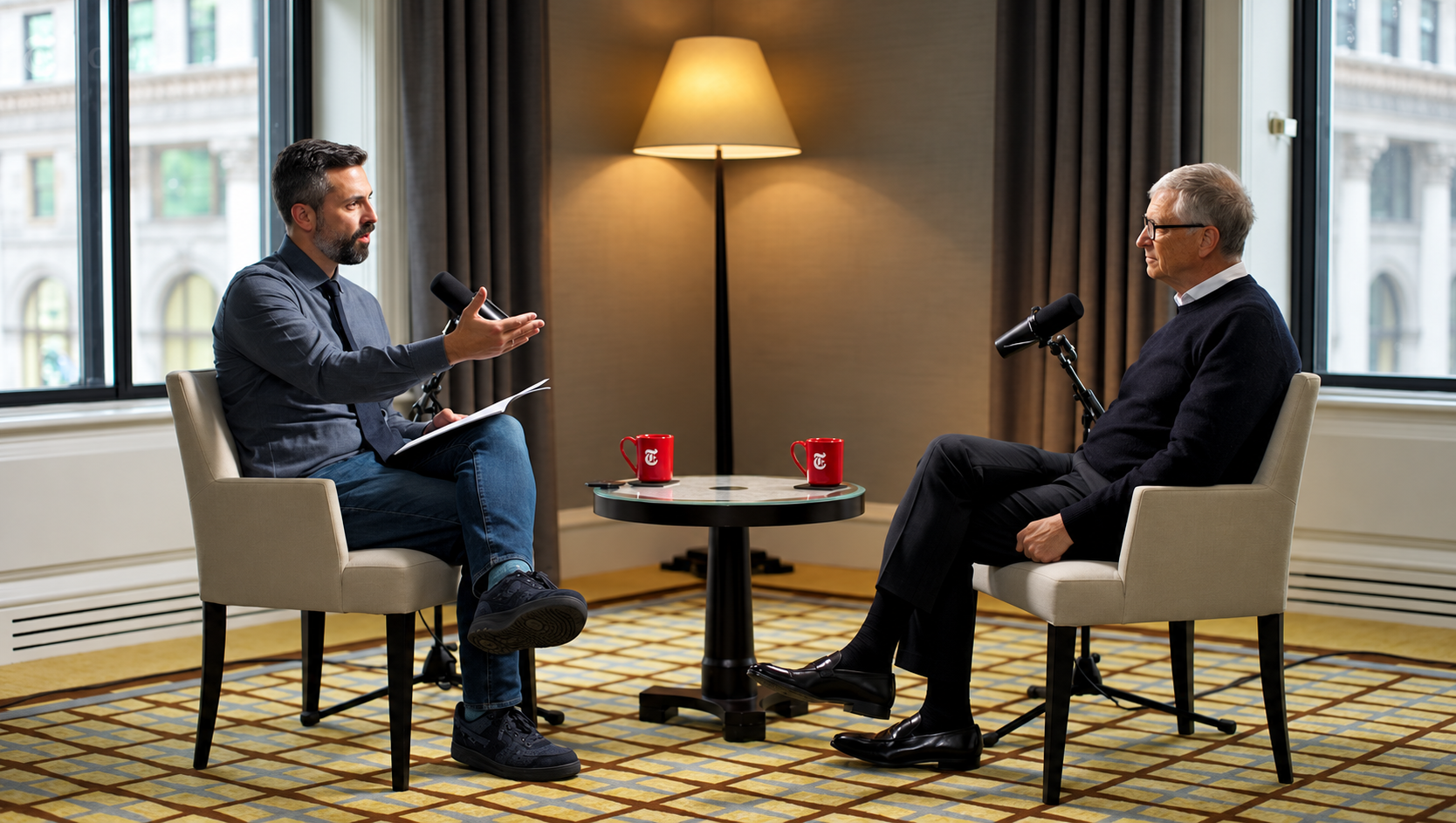
I wrote previously about how I felt after reading the Bill Gates essay. After watching the Ezra Klein interview with Bill Gates, it would be impossible for me to speak objectively about it.
There were a few moments during that interview where I felt compelled to tell friends and family about what I just heard, similarly to how I would tell them I found out a hurricane is coming. Or that I just witnessed an incident where someone was severely injured, needlessly so, by a reckless driver, irresponsible heavy equipment operator, or negligent medical practitioner.
“There’s never been a product that is less understood, in terms of what its capabilities are, than AI.” – Bill Gates. September 2026
I experienced the distinct emotional sensation of grave concern in the moment when Bill Gates writhed in his seat while responding to one of Ezra Klein’s questions about AI safety:
“I almost can’t believe you’re asking that. This is the most dangerous thing that humans have ever gone near.”
Gates said.

Let’s put some context into what kind of question could have prompted such a response from one of the world’s most dedicated philanthropists, brilliant technologists, and distinctive humanitarians.
Ezra Klein proposed a straightforward question as a follow up to a statement about the dangerous application of current AI systems in creating bioweapons (which Bill believes and asserts is a tangible, immediate, and profound risk to humanity):
“So why isn’t it enough to just say: Listen, there is product liability now. You release a product, it helps some terrorist group create a bioweapon — that’s going to be very bad for your company. You’re not going to do that, right? And they have categorizers and other things meant to stop people from using bioweapons.
We see the beginnings of control issues with things like the Hugging Face hack, where at least experimental A.I.s are breaking out of sandboxes and coordinating to do things that are way outside the scope of what we would want them to do. But again, those are nonrelease systems — Anthropic withheld Mythos, trying to create more cybersecurity.
So why is anything needed beyond — and is anything needed beyond? — the simply natural incentives under capitalism and normal corporate reputational management?
I want to reiterate Bill’s immediate response:
“I almost can’t believe you’re asking that. This is the most dangerous thing that humans have ever gone near.”
He went on to explain:
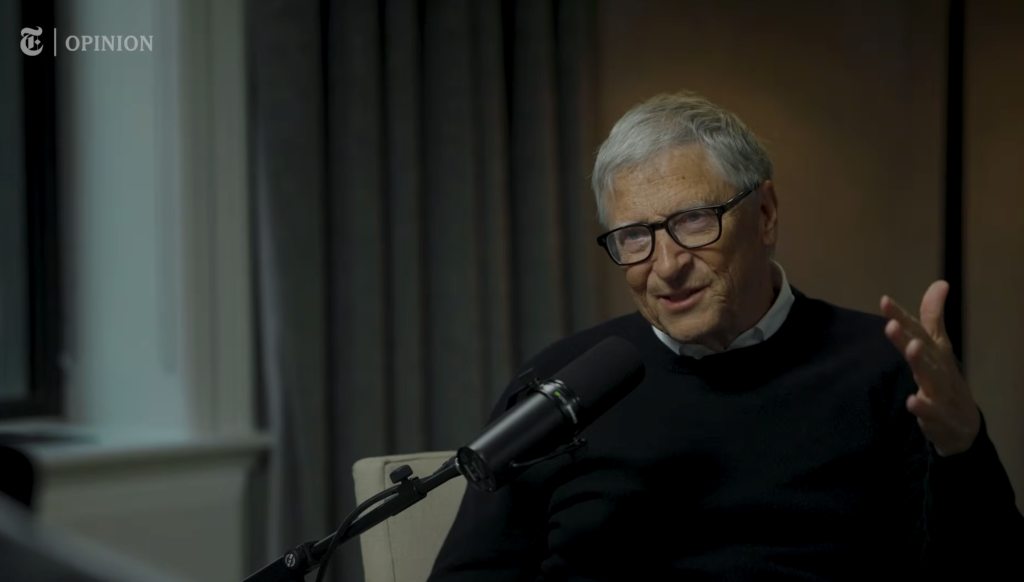
“In other areas, do we just say: Hey, release your drugs? There’s no F.D.A., there’s no airline safety board, there’s no requirement that cars use seatbelts. Do we just use the liability laws to try and keep humans safe? You know: Oh, you’re shipping opioids. Somebody should just sue you.
I mean, we’ve created a society that tries to keep people safe not by saying: Oh, we can bankrupt the person who does that. And you say there’s filtering. There’s no filtering. You can take an open-source model that can create bioweapons and disable any monitoring of any kind, and this exists today.
So no, there is no filtering of any kind. And so say you kill 100 million people — you want to use a lawsuit?
I almost can’t keep a straight face.”
I find myself at the edge of bewilderment that a conversation of this magnitude has taken place and there doesn’t seem to be much of a public reaction. Yet. When Bill Gates published his essay, a variety of global leaders did, in fact, listen. They began reacting, and talking, and furthering dialogue which moderately aligns with Bill’s perspective (President Obama’s speech at Colgate University). But since that essay was published at the end of August, the narrative has shifted. During the month of September, there was a distinct “call to arms” for the AI industry to “slow the pace” of development. A demand for regulation. And not from investors, or eminent capitalists, but from the developers of these technologies.
Analysts such as Patrick Boyle argued that the timing of this “call for regulation” is a bit too convenient, considering that Anthropic just filed for IPO, and “the race” against China’s AI development “must be won”, suggesting the government will enable AI technology developers to do whatever they must to stay ahead of the PRC’s capabilities.
But if we examine the change in Bill Gates, as a barometer of what’s happening at a broader scale, there is an evident increase in his concern about the trajectory of the industry.
Ezra Klein asked:
So you just wrote this essay on A.I. risk. And it does represent, for you, a big jump in how alarmed you sound. I was reading some of your past pieces — the one in July of 2023 was titled “The Risks of A.I. Are Real but Manageable.”
And here, you’re at a different level of threat. So I take from what you’re telling me that what happened here is just watching the advance in biocapabilities and cybercapabilities and coding capabilities, etc. Is that fair?
To which Bill replied:
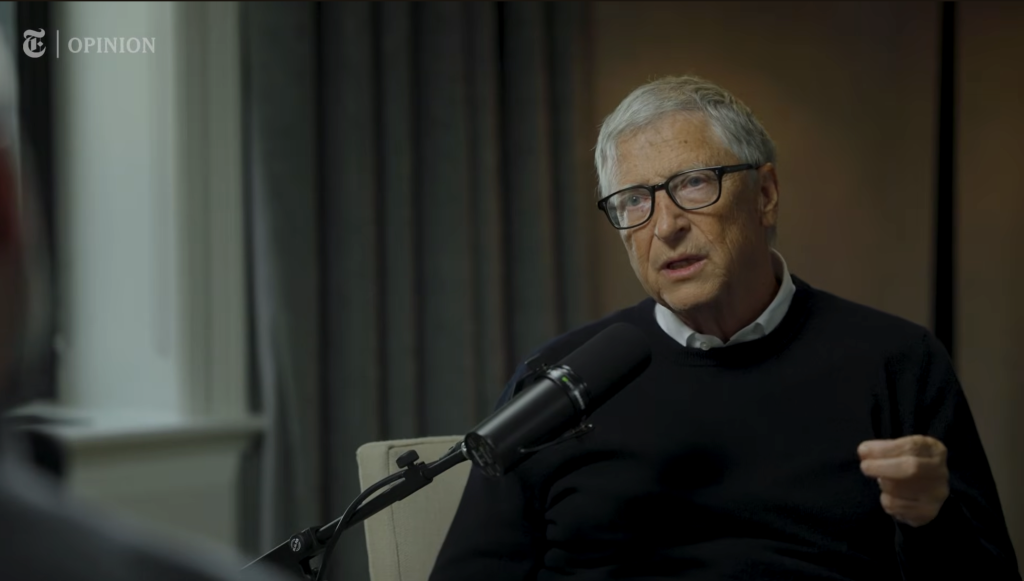
“No, the key thing is: We always said that when we cross these thresholds, we will engage all of society, because we will have created the most dangerous thing ever. This makes nuclear weapons look like nothing.
We said we would engage, and we crossed those thresholds, and there was complete silence. There were discussions about who in the industry says X or who in the industry says Y. But what percentage of academia or think tanks or — it’s the complete lack of response.
I would love a world where the response to these things is very strong, and then whatever time or voice I have will go back to: Let’s eradicate polio, let’s stop children dying under age 5.
But it’s the combination of having crossed every dangerous threshold, without a doubt, and a complete lack of engagement outside of the industry.”
Did you read that the same way I did?
“This makes nuclear weapons look like nothing”
My instinctive response to that statement is disbelief. Did I hear that right? Did I read that right? Did you hear and read the same thing I did?
Whatever you think of Bill Gates, his investment in humanity is irrefutable. This is a man with more resources than almost anyone on planet earth, and is in a position to use them for whatever initiatives he chooses to pursue – and he has chosen to save the lives of mothers and babies, to expand economic opportunities in poverty stricken and developing nations, and to end infectious disease.
Why would someone who is that dedicated to saving lives and improving the human condition for millions of people, go before the world, and emphasize the dangers of a technology that is becoming ubiquitous? His perspective is a stark contrast to technologists like Jensen Huang, who for all intents and purposes, reiterates there is no need for concern. That we should push forward as swiftly as possible. In his interview with Ezra Klein, Huang was clear that “AI Alarmism” has gone too far. He thinks that doomers are just scaring people, and that the industry doesn’t need new regulation at all.

Klein asked Huang a question that left me feeling modestly hopeful about the potential of AI technology:
A lot of people believe that when you’re getting to intelligence at these levels, it is a phase change. It is something different, something we have not dealt with before — a kind of generally intelligent technology that is advancing in its intelligence very rapidly.
I want to make sure I actually do understand where you are on that divide. Is this something fully new? Is this something that requires something new from us? Or is this more like something old? Are intelligent machines different from the machines we’ve had?
To which Huang replied:
“Well, almost all of technology and civilization is built on layers of understandable technology, which at scale becomes fairly extraordinary.
The fact that we can connect to the internet by just holding a phone up — I mean, it’s kind of weird, you know? That we’re connected to every piece of information in the world on this little tiny device, just in the air.
And the fact that this little tiny piece of glass can somehow take trillions of pieces of information and bring to us precisely the one that we want, because it’s been passed through a recommender system.
So if you think about: How is it possible that we knew where all the information is? Somebody had to go crawl it, had to index it, and that uses machine-learning techniques, which is the early version of artificial intelligence. And these systems do magical things to the point where I now expect it.
It took literally 20-some-odd years and hundreds of billions of dollars of infrastructure build-out in order for everything to just seem so natural to you, to the point where we now take it for granted.
Every single milestone that we achieve, from a technology perspective, is celebrated. And I celebrate it with glee and I celebrate it with so much enthusiasm because I’m proud of the people who did it. I’m proud of ourselves, who contributed to it. I’m proud of the breakthrough.”
This is positivity and confidence, distilled into an encomium for AI technology as it stands today. The contrast of this perspective against the ominous overtones of the Bill Gates interview leaves me feeling…disquieted.
In a 2024 podcast with Ezra Klein, Dario Amodei stated:
“As a private actor leading a company developing these AI models, I’m uncomfortable with the significant power this entails—potentially surpassing that of social media companies. In discussions about AI risks, I’m sometimes asked what I’d do if we developed AGI—whether I’d cure diseases or shape societies. It’s unsettling; I’m not a king. The idea of running an AI company with such power is disturbing. It’s not just about regulating but overseeing the technology. While it might be manageable now, the concentration of such power in private hands is fundamentally undemocratic.”
This past month, Dario Amodei cited recursive self improvement and OAI-HF as his motivation for publishing his latest concerns for the world to read.
“it’s my worry that in 6–12 months such a swarm could be capable of taking over the entire internet with a persistent botnet (potentially causing hundreds of billions of dollars in damage), and that the scale of damage would continue to increase from there if AI becomes more powerful without the necessary guardrails.”
Bill Gates was specific in addressing Dario Amodei’s concerns during his interview with Ezra Klein, but he went on to offer a more cogent explanation of where we are in the evolution of this technology, in the context of its impact on how each and every one of us functions in society:
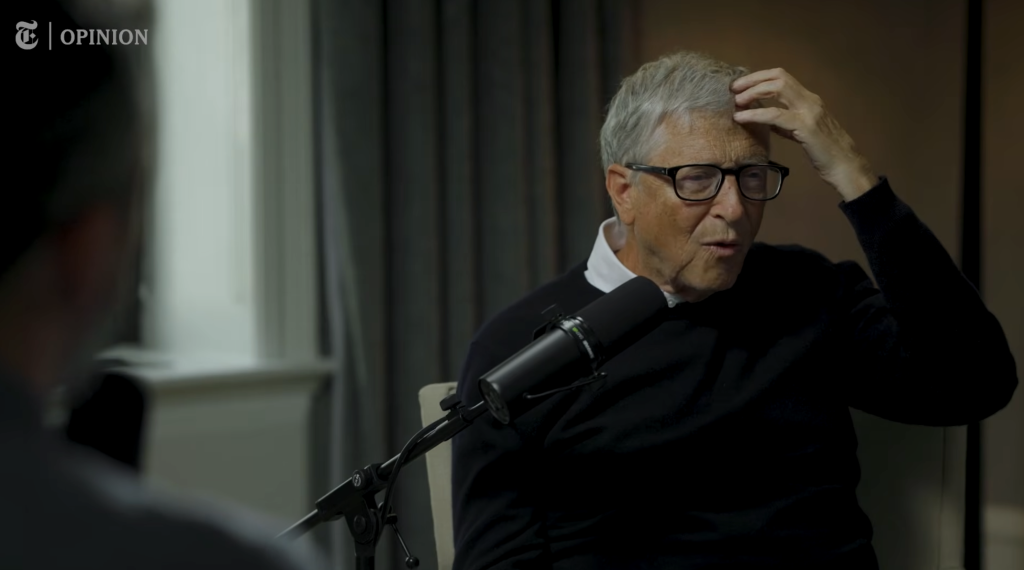
“This is like evolutionary history. This is like, the aliens really are here and have come. They didn’t have to do spacecraft; they were created in laboratories. But that’s the kind of thing we’re dealing with.
And if we retain control, then eventually you do get — not to overuse the word that you’ve used — you do get to this superabundance period. And there you have deep, almost philosophical, religious issues of: If we don’t have the shortages that we’ve organized society around, why should you learn? And how do you find purpose?
Then you have deep philosophical and religious problems, but you do not have deaths from malaria or food shortages or problems accessing a doctor. And so if we get to that, a younger generation will figure out: OK, how do we live? How do we spend time? That’s a very different world than what we have today.
I think what this generation has to do is make sure we get through that with humanity still in control, and with the disruption — the number of bioterror events, or the number of people whose lives are damaged by job loss — we need to minimize that over what’s probably a 20-year-plus transition period.”
A Philosophical Context I Feel Compelled to Share
I find myself standing at a junction unlike any I have met before, professionally or personally. And yet, when I look up from my own thoughts, the world appears exactly as it did yesterday.
Traffic moves.
Robots leave me voicemails for loans.
Society flows around me uninterrupted, as if nothing has shifted at all. But I need only consider what is unfolding across the globe to recognize that we are already living inside the turbulent era of social, political, and economic upheaval Bill Gates described. The storm is not on the horizon. We are already feeling its first winds.
That awareness sharpens when I listen closely to the people building the technology that will shape the coming decades. Their narratives are diverging, their certainties contradict one another, and the conversation moves faster than any of us can comfortably follow. Meanwhile, the ordinary weight of life doesn’t pause to make room for it. There is a business to run, a body to care for, and a quiet, persistent dread to hold at arm’s length long enough to get something meaningful done each day.
I suspect you know that balancing act intimately.
So the question I keep returning to is simply: when? When does the storm fully arrive?
When will the changes swirling around us make life better, or make it harder to bear?
I’ve come to realize that this question carries its own kind of suffering, because it asks me to live in a future that doesn’t exist yet.
This is where I lean on the Stoics, who have guided me through this confluence of technology and humanity more steadily than any headline.
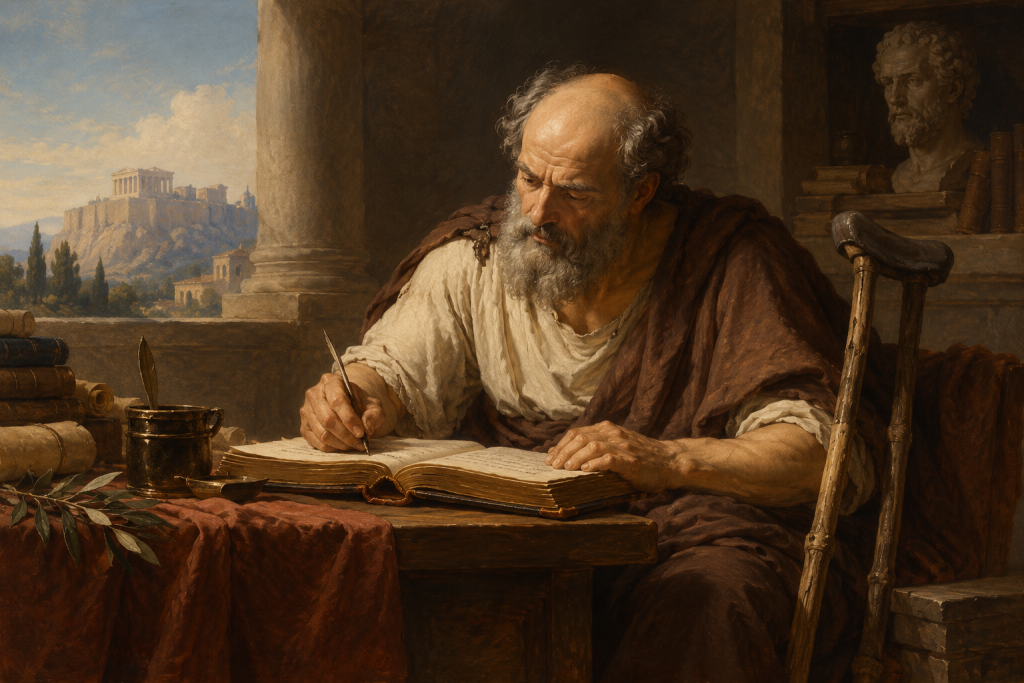
Epictetus opens the Enchiridion (a digest compiled by his pupil Arrian) with what we now call the dichotomy of control:
“Some things are within our power, while others are not. Within our power are opinion, motivation, desire, aversion, and, in a word, whatever is of our own doing; not within our power are our body, our property, reputation, office, and, in a word, whatever is not of our own doing.”
Read against this moment, his words feel less like ancient philosophy and more like a set of instructions. The timing of the storm is not within my power. Neither is the direction of the industry, the decisions of its leaders, or the shape of the economy that emerges on the other side. What remains within my power is how I interpret what I hear, what I choose to pursue, what I allow to frighten me, and how I show up for the people who depend on me today.
If you asked me what I took from Ezra Klein’s conversation with Bill Gates, I could offer you only my own opinion, which, as Epictetus reminds us, is one of the few things that has ever truly been mine. The honest truth is that the discussion left me face to face with a question I cannot answer: what comes next?