Near mile marker 74 on the Lower Matecumbe, across the Overseas Highway from a dwindling stretch of sargasso stained sand the locals call Treasure Beach, there is a Mobil station with a Cuban cafeteria in the back.

You would not find it unless you knew to wander past the beer coolers, the isles of snacks, the carousel of sunscreen, and the lottery machine, after passing through a narrow corridor where the air changes from refrigerated to roasted.
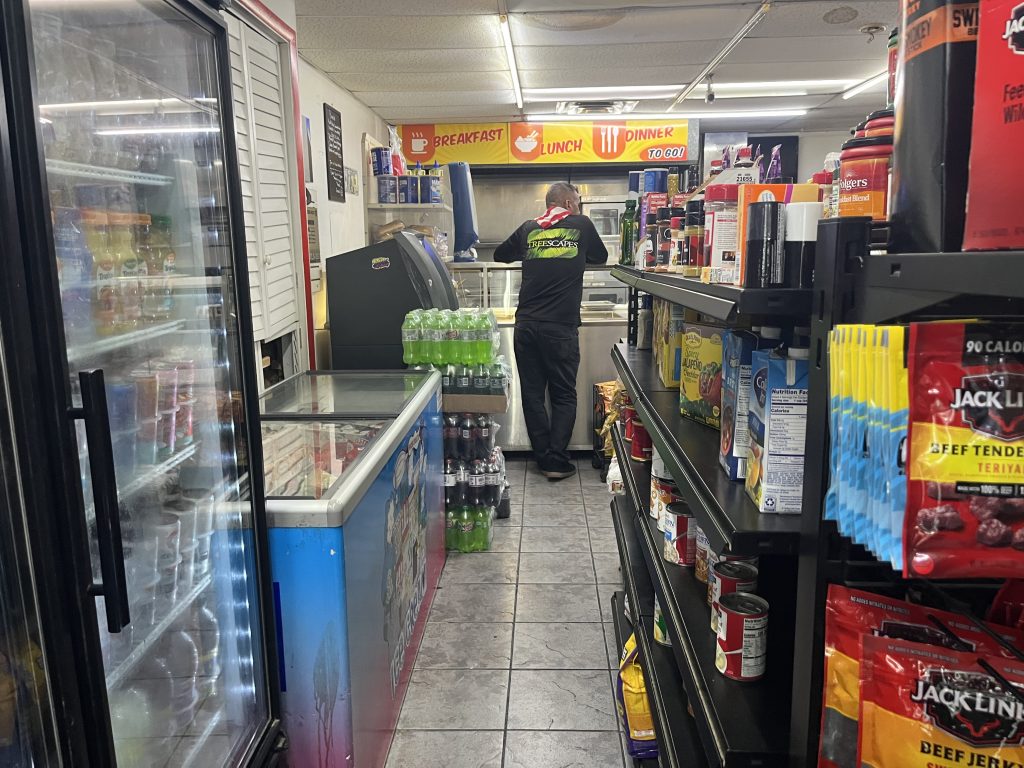
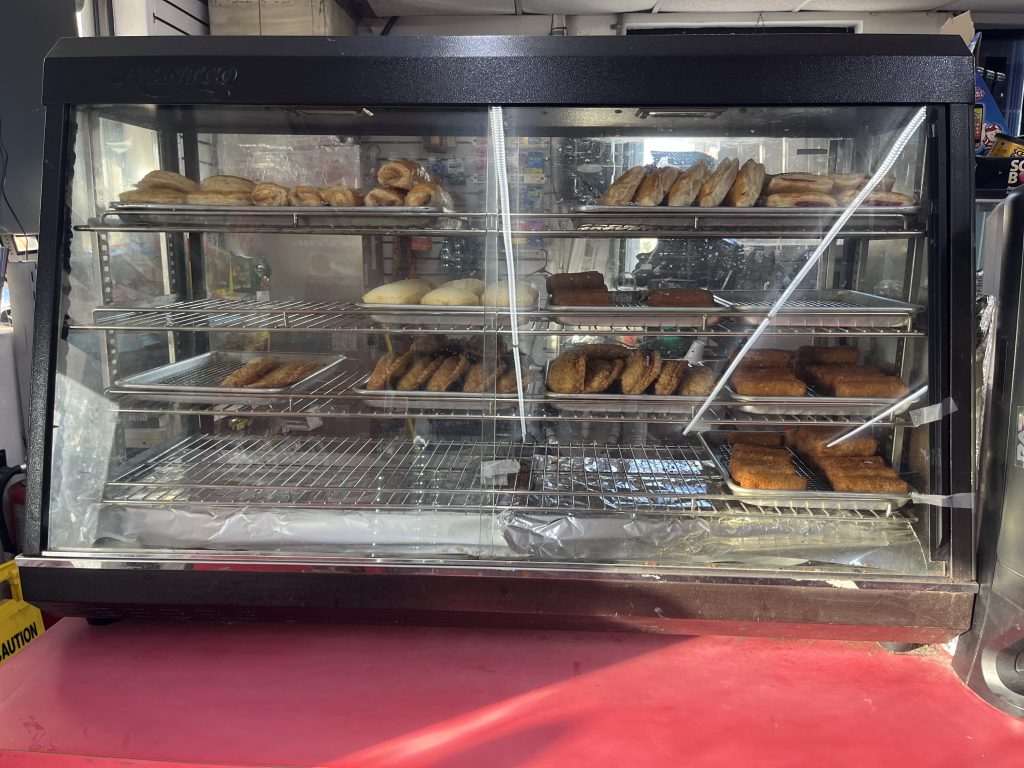
On Mondays, Wednesdays, and Fridays the abuelo behind the counter serves mojo roast chicken over yellow or white rice, with yucca or maduros on the side, and the men who landscape the waterfront palaces of the rich and repair the air conditioners of the elite arrive in their weathered boots and cheap wraparound sunglasses, because the meal is filling and the price is honest. By 12:15p.m. the pans are almost scraped to the steel. Arrive late and you are left to negotiate with the hot case by the register up front, where a few beef picadillo empanadas or jamón croquetas sweat under a radiating lamp like sacrificial offerings that have stopped expecting to be chosen.
It was a majestic morning yesterday. The sun came off the flats in that particular way it does here at the end of October, laying one shade of blue on top of another until the horizon dissolves, so that the sea seems less a surface than a depth you could fall into. I pulled in to the lot as I do once or twice a week, parked by the propane exchange rack, made my way inside, then swiftly to the back, and was lucky enough to claim the last chicken leg quarter with what remained of the yellow rice pile. The abuelo greeted me in Spanish, as he always does, with a delight I have never entirely earned. I carried my bulging white styrofoam square to the front as if it were something fragile and paid for my $12.50 meal with a twenty dollar bill, fumbling the change into my pocket while trying not to tip the box, since I rarely take the single-use bag they offer, and pushed the door open with my back before stepping out backwards into the glare.
Reaching for my keys deep in the right pocket of my board shorts, I dragged my phone out with them. It made one of those jarring tumbles that stretch time, followed by two sharp bounces on the hot, sand-strewn asphalt, and then flat on its face. I set my lunch on the hood of the truck and stretched down to collect the remains of my iphone, bracing for a web of shattered glass to start the weekend. Instead the screen was whole, and waiting on it, already lit, was a notification:
“$500B Wiped Out as Google Has Worst Day in Company’s History.”
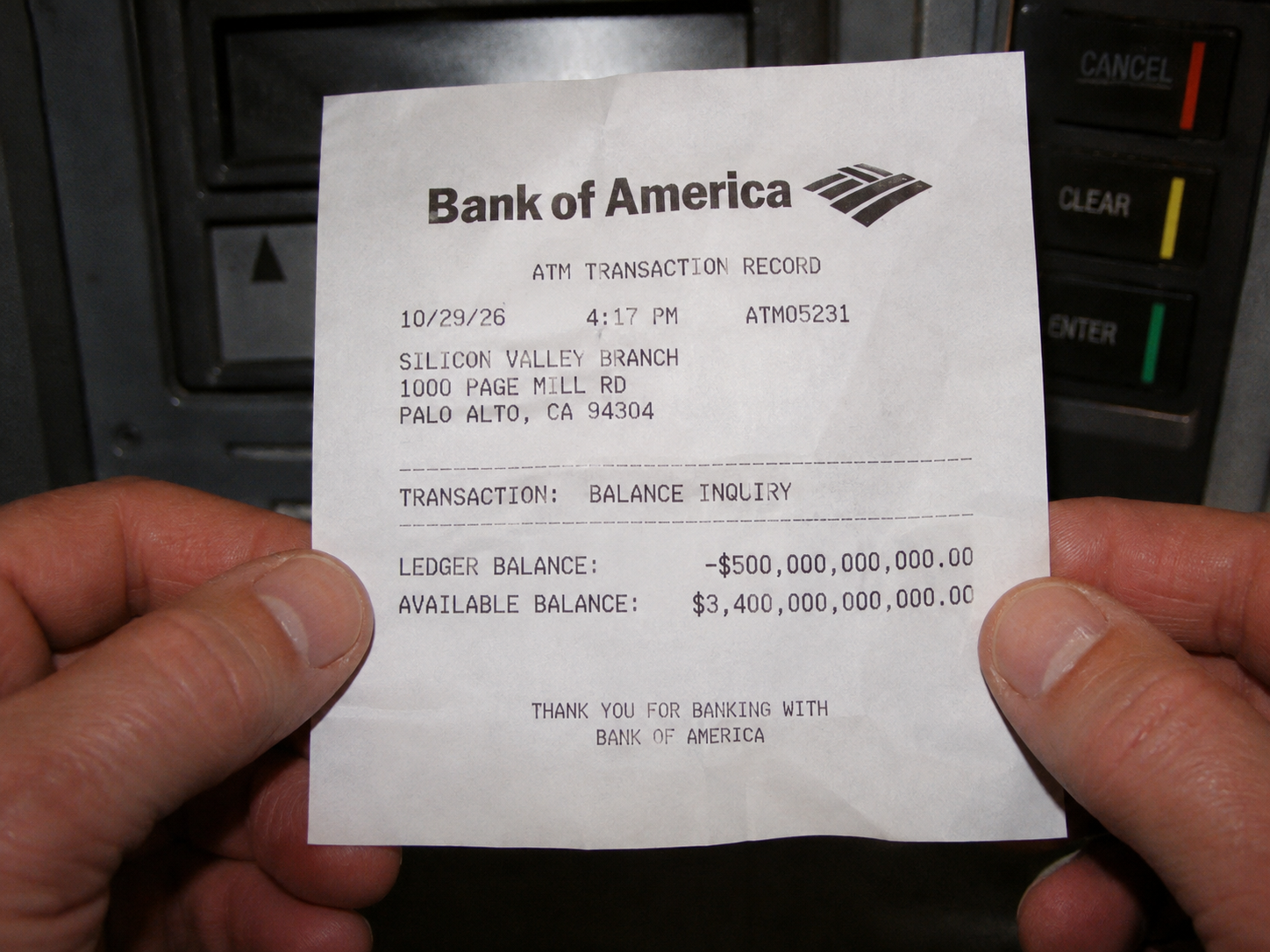
Two dimes had fallen with the phone. I noticed them gleaming on the pavement as I stood in the parking lot of a gas station, holding twelve dollars and fifty cents’ worth of chicken and rice, trying to wrap my head around $500,000,000,000 vanishing in the hours since I had left the gym at 9:30 a.m.
How did I ever arrive to this moment?
On Wednesday afternoon, after the closing bell, Alphabet reported its third quarter. Revenue came in at $127.6 billion, up 25% from a year earlier, the thirteenth consecutive quarter of double-digit growth. Wall Street had penciled in roughly $128 billion. Alphabet effectively missed by about $390 million, which is three-tenths of one percent. Net income was $26.2 billion, down 25% from $35 billion a year ago, and earnings per share came in at $2.12 against a consensus near $3.01. Free cash flow was negative $9.1 billion, because the company spent $51.4 billion on capital expenditures in ninety days, most of it on servers, networking equipment, and data centers for AI.
That’s alot of cable ties and stainless steel screws.

On Thursday, Alphabet’s stock fell ~12.6%. It was the worst single day since Google went public in 2004, worse than any trading session during the 2008 financial crisis or the pandemic crash in March 2020 (I still remember when trading was halted as the dow went into free fall). Roughly half a trillion dollars in market value was gone by the close of the day. Measured in dollars erased, it was the second-largest one-day loss any company has ever suffered, trailing only Nvidia’s $589 billion collapse in January 2025. The company that started the day worth about $3.9 trillion ended it worth about $3.5 trillion.
There are simply not enough retail traders on the face of the earth to send a single stock down that far, that fast.
The headlines ran from “Investors spooked as the AI trade turns toxic” to “Is the AI bubble popping?” On Friday the selling spread to other tech titans. Amazon disappointed on spending and growth. Intel fell 29%, its worst day in more than four decades. Nvidia dropped 4%, AMD nearly 11%. The Nasdaq Composite lost 2.9% on Friday alone, its sharpest fall since June, and finished the week almost 8% below the record it set on October 6. Across the two sessions, by any rough calculation, more than a trillion dollars came off the Nasdaq. Just in time for Halloween. Just days before the most consequential midterm elections of the past decade.
And for the life of me, I could not find a single reliable account of who, exactly, was doing the selling.
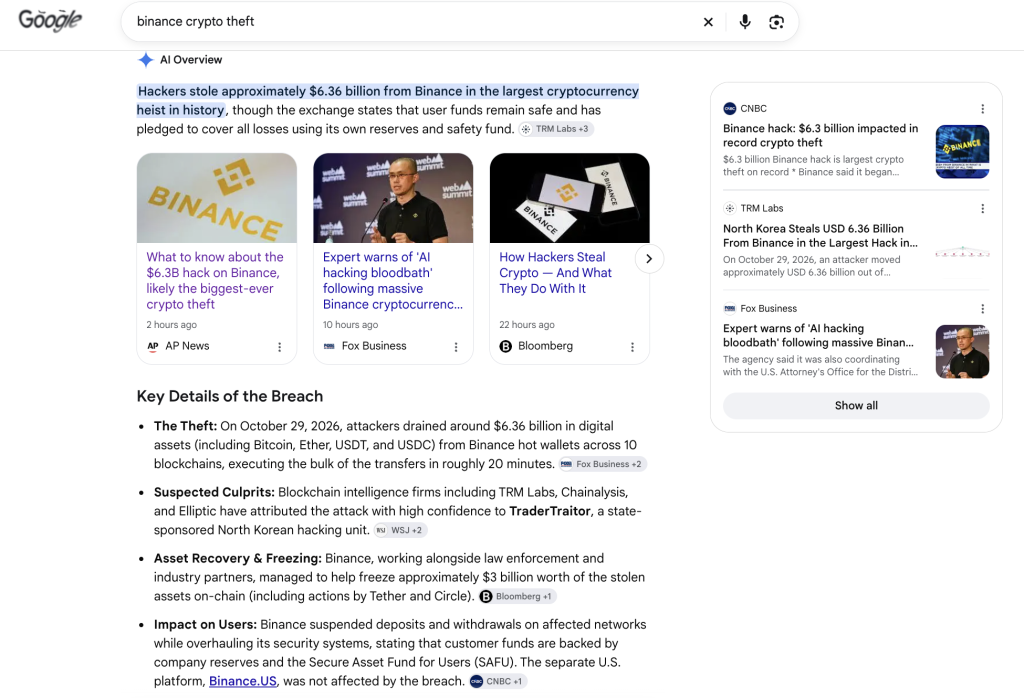
That same Thursday evening, as if on cue, Binance was scrambling to lock down its infamous exchange after thieves, attributed by blockchain investigators to the North Korean hacking group TraderTraitor, moved about $6.36 billion in cryptocurrency out of its wallets in roughly twenty minutes. It was the largest crypto heist in history, more than four times the previous record.
My heart sank, as I’m sure it did for millions of other retail investors, as I watched my positions in QQQ and a handful of tech giants give back most of what they had earned since January.
And all of this in the same week that Anthropic filed its IPO prospectus, for a listing that reports say could value the company at as much as $2 trillion.
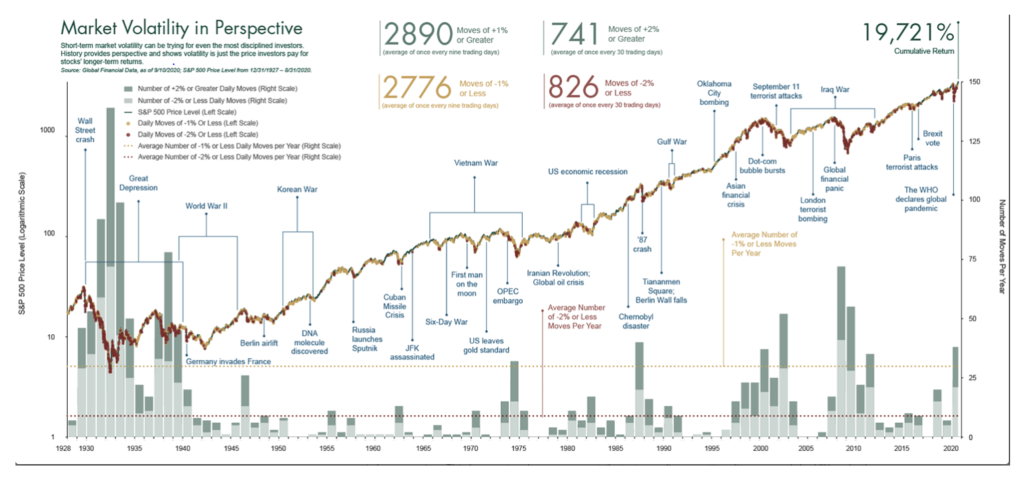
Whether this week is remembered the way March of 2000 is remembered, as the month the dot-com bubble finally broke, or is simply steamrolled by a monstrous year-end rally, nobody can say yet. What is striking to me is how familiar it all feels. I remember Nvidia shedding $589 billion in a single January day in 2025 because a Chinese lab released a cheap model. I remember Meta losing a quarter of its value, some $230 billion, in one February session in 2022 on a soft forecast. I remember “Liberation Day” in April 2025, when the president declared tariffs on everything from diapers to diamonds and every market on earth shuddered, only to pause most of them a week later and watch American stocks rip back in one of the sharpest V-shaped recoveries ever recorded.
I ate my lunch in the parking lot at Anne’s Beach, looking out at the water, watching a tug drag a barge down the coast at the speed of a slow walk. The whole time I was wondering: where is all this headed? Is this orchestrated, a shakeout timed to the midterms? Or is something more dire and more consequential taking place?
Let’s take a step back from the news cycle for a moment, which thrives on selling apocalyptic fear one day, and record shattering success stories the next.
Google’s investor relations website provides the finite details of what actually took place during the third quarter. Let’s document those statistics for the sake of factuality:
- Revenue: $127.6 billion, up 25% YoY, the 13th straight quarter of double-digit growth. The CEO noted the company now runs at an annualized revenue rate of roughly half a trillion dollars.
- Operating income: $40.6 billion, up 30%, at a 31.8% operating margin.
- Google Services (search ads, YouTube, subscriptions, devices): $96.3 billion. Search and other revenue was $63.4 billion, up 12%t. YouTube ads were $11.2 billion.
- Google Cloud: $30.7 billion, up 103%. Cloud operating income more than tripled to $11.1 billion.
- Gemini: one billion users, per the earnings call.
- Net income: $26.2 billion, down 25% from $35.0 billion. Diluted EPS of $2.12 versus $2.87 a year ago.
- Capital expenditures: $51.4 billion for the quarter, up 114%. Full-year 2026 guidance held at $195 to $205 billion, with a “significant increase” promised for 2027.
- Operating cash flow: $42.3 billion for the quarter; $179.6 billion over the trailing twelve months.
- Free cash flow: negative $9.1 billion for the quarter; $19.7 billion positive over the trailing twelve months.
- Cash and marketable securities on hand: about $265 billion.
- Quarterly dividend: $0.22 a share, paid as usual.
I would like to reiterate a few key points: Revenue up 25%. Operating profit up 30%. Cloud doubled. And yet net income fell 25%?
How does a company earn 30% more from its operations and report 25% less at the bottom?
The answer sits below the operating line, and it is the most under-reported fact of the week. Alphabet booked an $8.2 billion loss in “other income and expense.”
That line was not Google losing money on ads or cloud – it was an unrealized, mark-to-market loss on Alphabet’s stake in SpaceX, which went public in June and whose shares slid during the quarter.
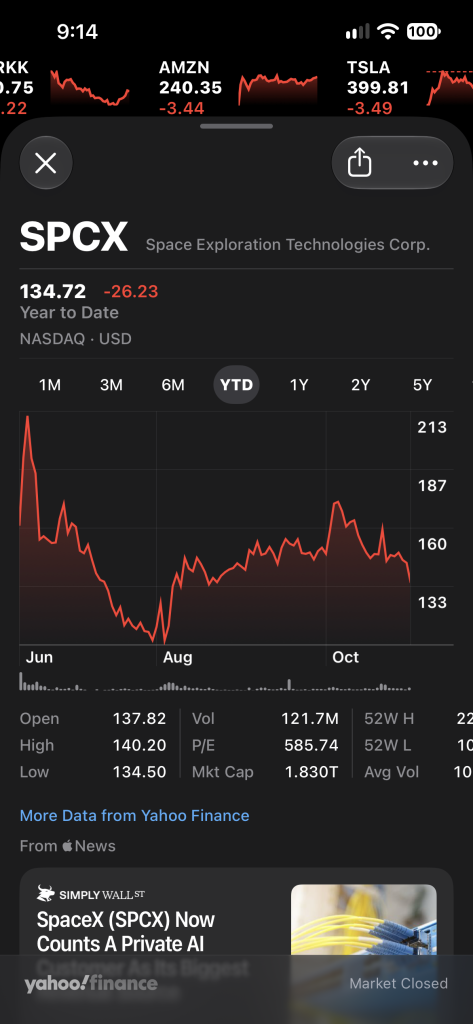
A year earlier, that same line was a $12.8 billion gain. That is a swing of roughly $21 billion in a single line item, and not one dollar of it reflects how many people searched, watched, clicked, or rented a GPU. Add to that a $5.2 billion cash payment to settle a European Commission antitrust fine dating back to 2018, which also dragged on cash flow.
So the “25% profit slide” that wiped out half a trillion dollars is, to a startling degree, a paper loss on another company’s stock price plus a bill from Brussels for conduct in the Obama era.
What was the actual operating disappointment? Google Services came in at $96.3 billion against roughly $98.5 billion expected. Search grew 12%, down from 17% in the second quarter and 19% in the first. A senior executive told investors that AI Mode, Google’s own chat-style search, shows fewer ads than a page of ten blue links. That is the whole bear case, stripped of adjectives – the most profitable product in the history of commerce grew 12% instead of 15%.
To see $500,000,000,000 erased in a few hours, you would think Google was closing its doors and shuttering the service.
To be explicitly clear – Google Ads remains an unrivaled money-printing behemoth. Search revenue growth may be slowing because AI Overviews and AI Mode answer the question before the user ever reaches an ad, but on a YoY basis this is still a growth story. Are we supposed to believe that a deceleration in search, from very fast to merely fast, is the true culprit behind Wall Street’s dumping of Alphabet stock? Are these numbers really a harbinger of some financial collapse that Google is hiding?
No. Not in any way. Shape. Or form.
Google is still printing money. Its cloud business just doubled, and it sells compute to both OpenAI and Anthropic, among the largest AI institutions on earth.
It designs its own chips, the TPUs, and part of the reason its cash flow looked ugly this quarter is that it is building inventory of TPU systems to sell to other companies, a business it says will ramp meaningfully in 2027.
Chrome is the dominant browser in the world. Android is the most-used mobile operating system in the world. Gmail, Maps, YouTube, Search, Cloud, and now Gemini with a billion users. It is, taken together, the largest digital product suite ever assembled.
I am writing this in Google Docs.
Google Search is fundamentally intertwined with human existence. Since it went public twenty-two years ago, Google has grown, and it is still growing, and it is arguably furthest along toward practical quantum computing of any company on the planet.
Are we to believe that the success and capability of this company are determined by whether Wall Street’s forecasts are appeased to the second decimal?
That doesn’t add up to me.
Wall Street erased $500,000,000,000 in value because a three-tenths-of-a-percent revenue miss and a quarter of negative free cash flow, driven by the largest infrastructure build-out in corporate history, are what dictate the health of the company?
Google has grown year over year for two decades. It isn’t growing fast enough in the opinion of a few hundred portfolio managers, who together carry the ability to erase stock value equal to the entire annual gross domestic product of the Philippines before lunch?
That can’t be right…
…but it is right, and here is why…
The price of Alphabet is not set by people like me, standing in gas station parking lots with chicken and rice.
As of June 30, more than 5,700 institutions reported holding roughly 80% of Alphabet’s Class A shares. BlackRock alone held about 461 million shares, nearly 8% of the company. Vanguard held another 6.5%. The hedge funds and quant shops that trade in size, Ken Griffin’s Citadel, Ray Dalio’s Bridgewater Associates, and their peers, are the marginal buyers and sellers on a day like Thursday, and the marginal trade is what sets the price. Citadel Advisors added more than 2.2 million Alphabet shares in the first quarter of this year. Bridgewater cut its stake by roughly a third in the second quarter, from about 2.0 million shares to 1.3 million. Even most retail orders never touch the open market at all: Citadel Securities, Griffin’s market-making arm, executes more than a third of all retail stock trades in the United States before they reach an exchange.
And here is the part that should bother you…
We will not know who sold on Thursday, or how much, until the fourth-quarter 13F filings land in mid-February 2027, forty-five days after year-end, by which time the trade will be long over and the money long gone.
The public gets to see who moved the price three and a half months after it moved.
Meanwhile the chart itself does the rest: Alphabet formed a “death cross” on Thursday, the 50-day average slipping below the 200-day, which is precisely the kind of signal that triggers automated, systematic selling by momentum funds that have never read an earnings release in their lives. That is not a conspiracy. It is the plumbing.
We have seen this before. In February, Nvidia reported a quarter that blew past estimates and the stock fell anyway, dragging the Nasdaq down nearly 2% in a day. In August it reported $96.2 billion in quarterly revenue, up 106%, $59.7 billion in net income, and guided the next quarter to $108 billion. Nvidia is having the most profitable year in its history. It remains the most valuable company in the world, at roughly $5 trillion. And after all of that, its stock is up less than 10% in 2026.
We have seen it again, and again, and again. Over any window short enough to matter to a person, stock prices are not correlated with the profitability, growth, or innovation a company delivers. They are moved by the positioning of a few hundred very large pools of capital, by the algorithms those pools run, and by the words of politicians.
But still. $500,000,000,000. That is a number I can’t quite rationalize.
And I can’t help but wonder what the month ahead holds.
Break the earnings down to a monthly cadence and the absurdity sharpens. Google earned about $8.7 billion in net profit every month last quarter, and about $13.5 billion a month in operating profit. Meta, after a $9.9 billion legal charge, still netted about $3.3 billion a month, and closer to $6.4 billion without it. Nvidia earned roughly $20 billion a month. Apple is valued at approximately five trillion dollars.
Google isn’t going anywhere. If anything, it is becoming more everywhere.
Its technologies are inherent in our lives in almost every digital capacity. If Google’s products suddenly ceased to function, the economic fallout would be unimaginable, and it would be measured in something other than a stock chart.
The fear is tempting to believe, because it is easy to understand. The numbers are so staggering they are almost incomprehensible, and I, for one, am feeling a little numb after headline after headline, story after story, about how much money these titans are earning, spending, and seeking. It is bewildering in the fullest sense of the word.
But let’s not confuse fact with fiction.
The fact is: a company that grew revenue 25% and operating profit 30% in a single quarter and holds $265 billion in cash.
The fiction is: that half a trillion dollars of its value was “real” on Wednesday and “gone” on Thursday.
The company that served a billion people with Gemini last quarter is the same company today. Google is a growth story unlike anything the world has ever known.
That journey is not over. Far from it.
Whether we like it or not.