I heard about it (in actual person to person conversation) from several friends and colleagues I consider talented in their respective crafts, mostly writing and photography.
They referred to it as “Instagram for smart people”, an “actual community of writers”, and even a “forum for modern philosophical debate.”
That sounded exactly like something I would be thrilled to explore.
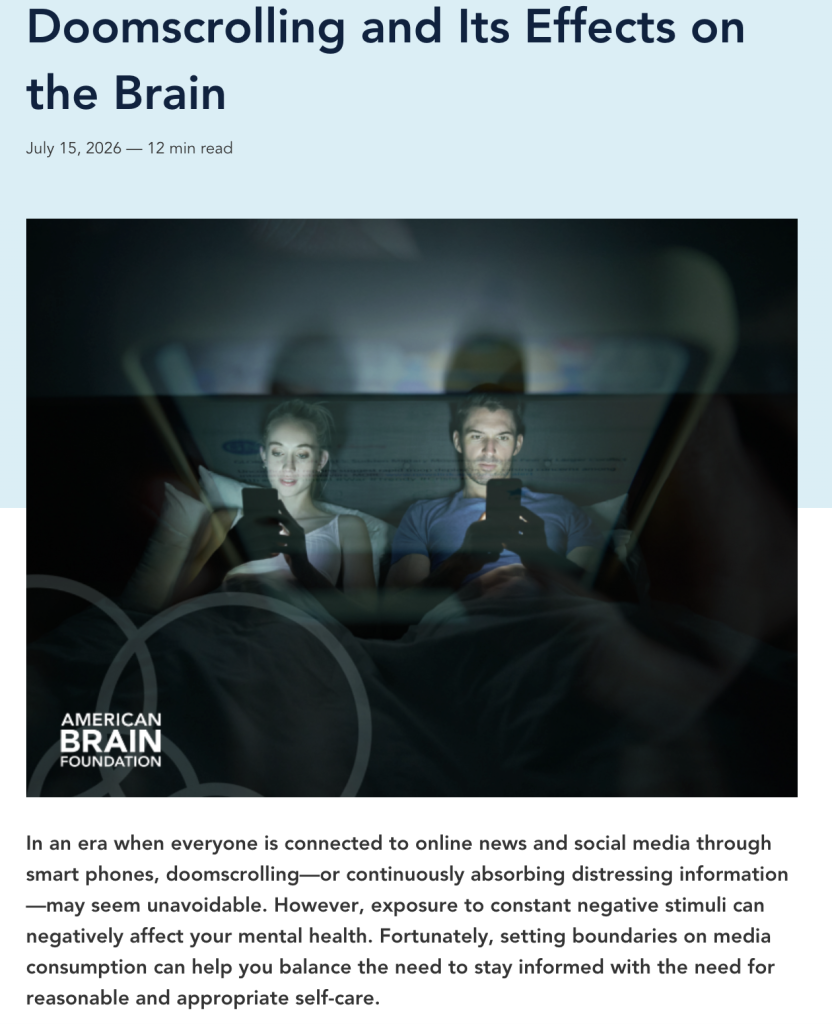
My disdain for Instagram and Facebook is well known amongst the people who know me best – professionally and personally. There is no more argument about the toxicity of Meta’s ubiquitous platforms, their addictive nature, and the damage they’ve done to the aggregate mental health of the United States.


TikTok is hardly different, and it’s only recently that I’ve started seeing more, and more, and more articles about the negative effects of endless scroll, “echo chamber” feed personalization, and the overwhelming volume of AI generated content that distorts reality.
That’s partially what drove me to experience Substack for myself – to understand what it is, what kind of people use the platform, whether it has any practical value, and if it is something I could finally embrace as a creative resource. As a professional internet marketer of 17 years, I’m always looking for new ways to help my clients leverage burgeoning platforms and technology to achieve their goals. It also means I know what an engagement machine looks like from the inside.

So I made the commitment to use Substack every day for a month to get a full dose of what the platform has to offer.
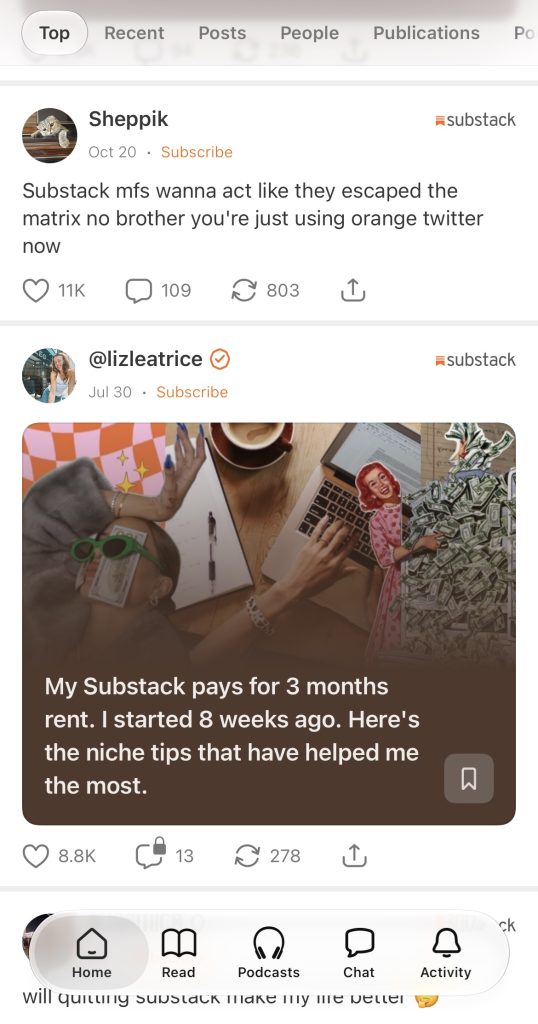
After 30 days of “Stacking” (is that what it’s called?), scrolling through a seemingly endless repository of essays, and posting “notes” for no specific reason at all – I am less than impressed with the tangible benefit of Substack. I found the “pain points” I expected to find on a platform that isn’t particularly sophisticated in the context of publishing. What I didn’t expect was how familiar the rest of it would feel. I encountered the same compulsive collective of motivational personalities and self promoters who run rampant on Instagram, an alarming number of people publishing content to the effect of “is this thing on?”, and a substantial volume of posts (and essays) proclaiming “I’m quitting Substack”. The app experience is dominated by “notes”, which are reminiscent of Twitter, with people posting photos specifically chosen to drive engagement.
Now to be fair, I have also encountered some extraordinarily creative individuals who produce astounding artwork, exceptional creative writing, and photography that is nothing short of National Geographic quality. I found plenty of authors publishing thoughtful literature, heartbreaking exposés on their struggles with mental health, and all manner of comedians whose essays actually do make me laugh out loud. There’s even a growing contingent of “haters” who consistently call out the sociopaths and narcissistic self promoters pushing their “get motivated” or “how to be successful like me” ideology under the guise of “I did it, so you can do it too – buy my ebook”.
I like that.
But as a whole, so far, Substack is a net loss for me. There are a few points of frustration with the platform that I find sincerely troublesome, and they all trace back to the same root: what Substack is supposed to be for, and what it is actually built to reward, are two different things.
Let’s start with with the AI aspect / intrusion of Substack. Creative writing, technical writing, philosophical writing, genuine “writing from the soul” – these are incredibly difficult endeavors. I’ve always considered myself a capable writer. I hand write journal entries almost every day of my life, I have a B.S. in Communication from the University of Miami, i’ve worked as a journalist, and I take keen interest in the literary arts. I appreciate how difficult it is to translate thoughts, feelings, and intricate arguments into written words – and yes – from time to time I use Claude as a resource because Fable is a BEAST of a copy editor. I’d imagine more and more professional writers are using AI to “fill in the gaps” or to make obscure concepts more succinct. That’s the way the world is going.
But on Substack, there are clearly people who exploit the hell out of AI tools to crank out “notes”, essays, and various content assets that are specifically designed to get “likes” and “subscribers”. Sound familiar? It should. Substack needs to make money too – it takes 10% of every paid subscription – so it rewards the publishers who earn paying subscribers.

To preserve the “human element”, or at least to flag where it’s missing, Substack rolled out an “AI scanner” this past summer, powered by a third party detection tool called Pangram. Scan an essay or a note and it returns a percentage – how much of the text reads as human, how much as “AI Assisted”, and how much as fully AI generated. That sounds like a great idea, until you realize as a publisher that even if you write every, single, word of a note or essay – the tool can STILL call out AI influence in the writing.
That is unacceptable.
The last few essays I published on Substack were written, intentionally, without an AI assist from Claude. I did that specifically to test how the scanner would report on them. Before I publish a piece, I read the entirety of it out loud, to myself, in my office – an editing trick I adopted after taking a creative writing class at UMBC in 2002. There’s no doubt it helps me hear my own voice in written word and make changes so the editorial reads the way I want it to. If there are elements of my writing that sound like AI – I can assure you – I was writing in this manner LONG before AI systems were conceived. But still – even with a direct intent to create writing that was 100% mine, without any editing influence – the AI scanner came back with 92% or 95% human.
F*** that.
So I tried the alternate approach, and published additional essays that I used Claude to edit, prompting Fable specifically to preserve my voice, style, and tonality.
82% human. 86% human.
Unacceptable.
Look at those numbers side by side. Writing that never touched AI loses five to eight points. Writing that was edited by AI, with every idea and argument still mine, loses fourteen to eighteen. That’s a gap of roughly ten points between “no AI whatsoever” and “AI as a copy editor” – and the tool is already off by as much as eight on the work that should score a perfect 100. A reader who sees “92% human” has no way of knowing whether that means “used a little AI” or “used none and got flagged anyway”. The number looks precise, and it can’t be trusted to tell those two apart.
And I’m not the only one who picked up on this! Since the scanner launched in July 2026, writers all over the platform have been posting their own tests – human written pieces getting flagged, and fully AI written text sailing through as 100% human.

Why does this matter? Because among creative and philosophical writers in particular, there is a dominant stigma against using AI tools to create essays and articles. Even if the tools competently and cogently add to the efficacy of an article’s argument – other writers look down with immense condescension on anyone who uses Claude or ChatGPT to enhance their work. To them, it is the antithesis of what literature is supposed to be about in the first place – human expression written by the human hand. So when Substack tags genuinely human crafted writing as “AI Assisted” (even to a small degree), that piece does not receive the same amount of attention, simply because of the label.
The writer pays for the scanner’s mistakes. Substack doesn’t.
And while this is entirely anecdotal – it seems that succinct, basic, minimalist content written in a mild mannered tone avoids the “AI Assisted” label, which may be one more reason the platform is FLOODED with “notes”. If that holds up, a tool meant to protect human writing is penalizing writers with a distinctive, practiced voice and waving through the blandest content on the platform.
Now to be entirely transparent – you can disable the AI scanner on Substack, which affixes a “Not scanned” label to your piece. Some writers go as far as to preface their work with the same frustration I just expressed: “the AI scanner doesn’t work well, and claims my writing is AI when it’s not, so I don’t use it.” On its own, that label doesn’t strike me as good or bad. But in a culture this suspicious of AI, I’d imagine “Not scanned” reads to plenty of people as “something to hide”. So the choice is a number you can’t trust, or a label that invites suspicion.
I personally don’t care if an article or essay is “touched” by AI. I read it anyway and take it for what it is. What I do not read is fully AI generated text, because that’s not what I’m on the platform to experience. That is the distinction that matters to me as a reader – and from everything I’ve seen, it’s the one the scanner can’t reliably make.
Now, on to the subject of “Notes” and the compulsive “Instagramification” of Substack…
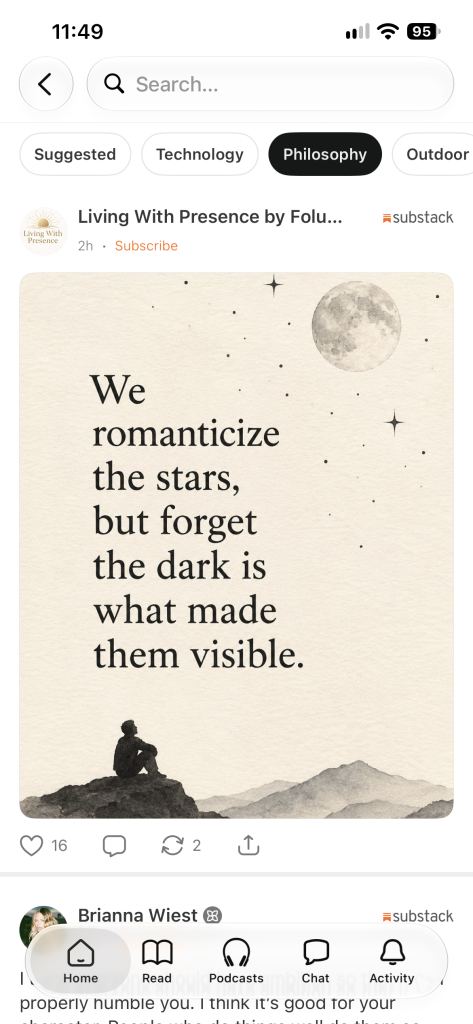
What the F*** are notes supposed to be? They are nearly the same as Instagram “posts” or X.com “tweets” (I don’t really know if they’re still called “tweets” after Twitter became “X” – whatever it is – I don’t care). My impression of Notes is extremely poor, because it strikes me as an endless cascade of short musings, thoughts, questions, and declarations that are not particularly valuable to me. And apparently, they’re not too compelling for anyone else either. Most of the Notes on my personal feed have no likes, or just a few. An occasional exceptional Note I come across has a thousand “likes”, a bunch of “restacks”, and a few dozen comments. And the ones with an enormous volume of Likes and Comments? Mostly innocuous and annoying.
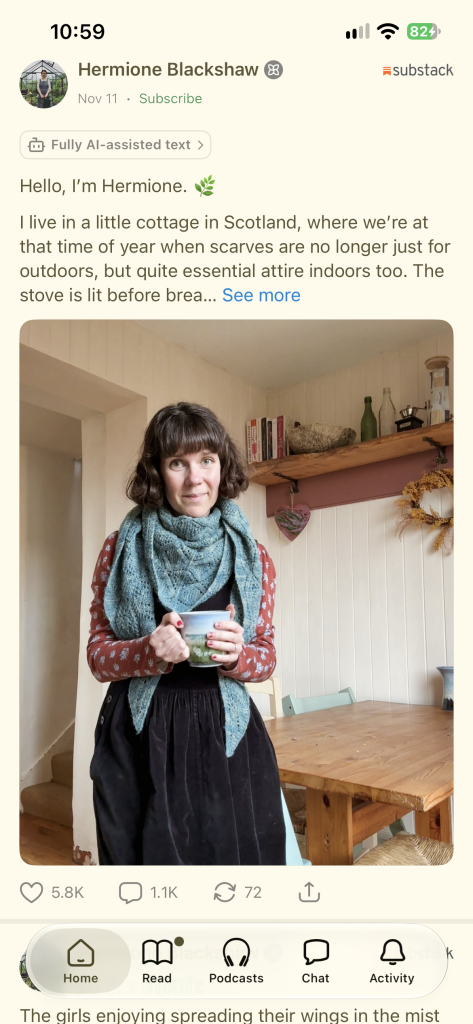
What in the absolute F*** is a note like this doing with 5,800 likes? It’s even clearly labeled as “Fully AI-assisted text”. And the comments? I will not dignify them with a screenshot.
I’ve seen a few Notes that effectively read “Hi, I’m [INSERT GENERIC NAME] and I live in a small cottage in the woods and write poetry” or “Just keep going. Whatever you’re going through, keep going” – or some other obnoxiously generic quote about perseverance or resilience. Then there’s the “I’m new on Substack and I write about [SOME OBSCURE INTROVERT TOPIC]” = 5,000+ Likes.

The volume of quotes from stoic philosophy, short bits about historical events, and Instagram-esque motivational quotes is desensitizing.
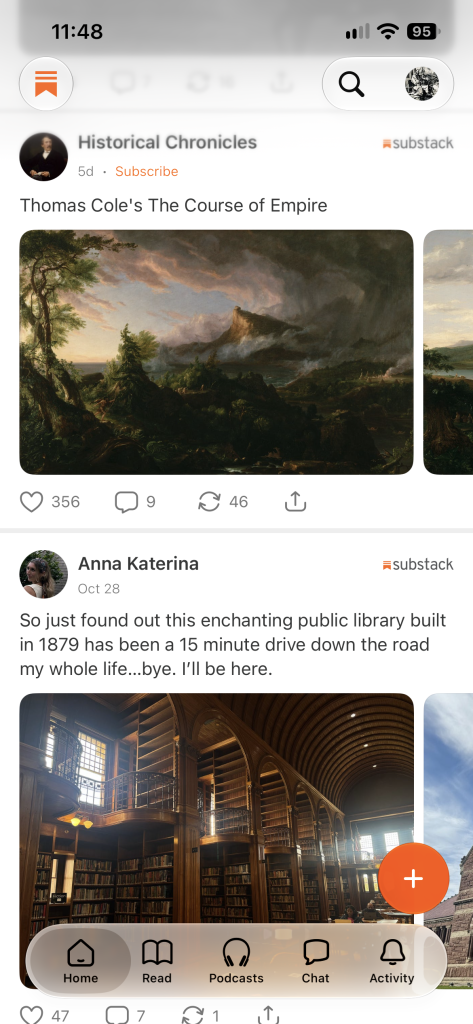
Notes are clearly, and specifically, designed to help people discover your “Stack”. They are a short form opportunity to post pictures, short videos, or whatever the hell else you can think of – to get attention. They have “likes” and “comments” just like every other obnoxious social media platform in existence, which feeds an annoyingly problematic behavior I catch myself committing every time I see a “successful” note (i.e. one with a shit ton of likes and comments) – I go straight to the person’s profile to see how many subscribers they have, and how active they are on Substack. I immediately feel in competition with that person, and I judge the quality of their Substack by how many other people are subscribed to it.
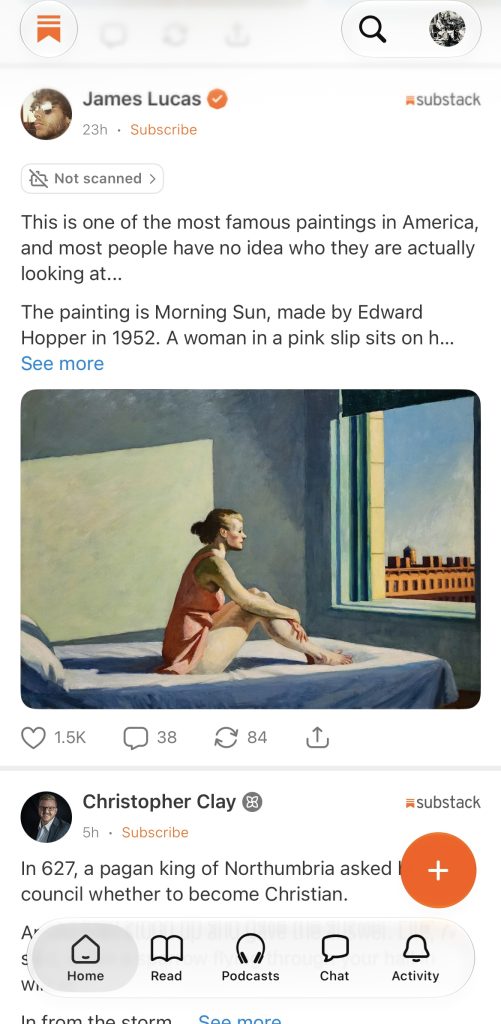
This individual did not create this painting, and somehow amassed 1,500 likes. This person has 83,000 subscribers.

This is unhealthy. And the antithesis of why I tried Substack in the first place.
What is most frustrating is that I didn’t even realize I was doing it for the first two weeks. It started as a form of curiosity. A way to understand “what works” and “what type of content” people want to read. As someone trying to build an audience on a relatively new platform that attracts writers and creative personalities, my natural marketer instinct drives me to understand what other people are doing to generate a substantial following. Is that a form of validation? Probably. Is that a healthy behavior on a platform intended for creative expression? No.
And here’s the part that bothers me most. I do technical marketing for a living when i’m not working as a Captain or dive instructor. I’ve spent 17 years studying how platforms capture attention and convert it into numbers. If anyone should have seen it coming, it’s me – and it still took me two weeks to notice I was keeping score. If it works that well on me, I’d call that the design doing exactly what it was designed to do.
So when I consider what Notes are intended to provide and how they are currently used on Substack – it’s the same old shit. Substack borrowed a successful function from Twitter and Instagram and made it inherent to their platform. That makes sense, if the goal is monetization. More engagement equals more subscribers. More subscribers equals more revenue. Creator gets revenue and Substack gets its piece. The logic behind pushing “stacks” that are monetized and have substantial followings is pretty clear – that’s what makes the company money. And creators are incentivized to chase an audience, because that’s what earns them money. Nobody in that loop gets paid for the quality of the writing.
To quote one of my favorite childhood books: “If you give a mouse a cookie…”
As a response to this realization, I made a conscious effort to stop worrying about building an audience or subscribers – and to focus on writing what I want, how I want, and publishing consistently. Is that a smart choice from a business perspective intended to monetize my Stack? No. Is that what Substack rewards? No.
So what’s the point? Connection? Community? Ah yes…community! That’s what the comments are supposed to be for…correct? Which brings me to the insatiable “comment arbitrage” I’ve witnessed on the Notes and essays that have massive traction on the platform.
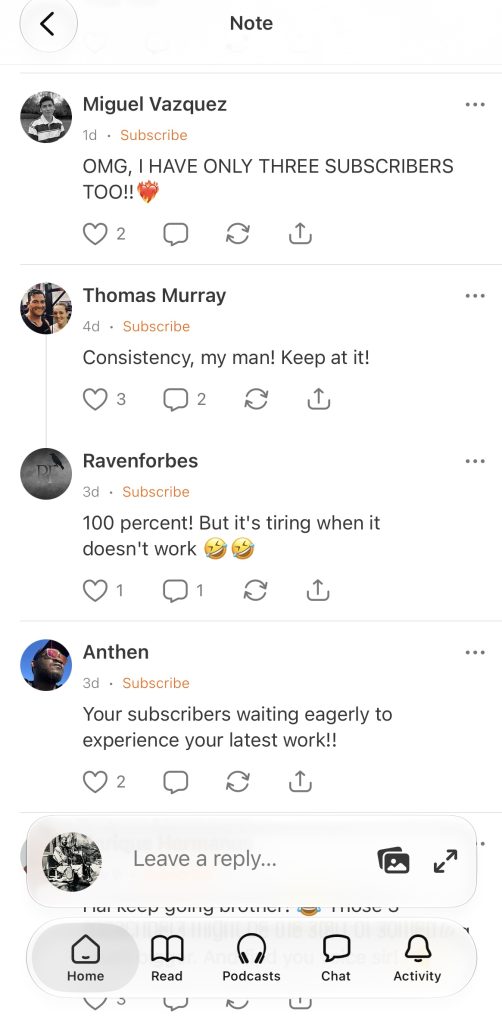
People come from nearly every corner of Substack to comment on essays and notes that are generating a large volume of “likes”, “restacks”, and comments. They do this specifically to build visibility for themselves. It’s obvious. I understand the concept of thoughtful and meaningful dialogue around a topic that a broad spectrum of people appreciate, or feel compelled to discuss -BUT – that’s not what this is. The overwhelming majority of the comments I see on essays and Notes with substantial traction are individuals attempting to make their presence known and siphon “subscribers” and “followers” to their own stack. It’s a strategy that has been in place on nearly every social media platform of the past twenty years. Those with a large subscriber base build momentum faster, and faster…and people show up to leverage that momentum to build their own following. Once the comment section becomes a billboard, the conversation is over.
That annoys me. Deeply.
To take a break from the negativity – and yes, my frustration with comments says more about how humanity has evolved in its use of social media than about the technical functionality of any one platform – let’s explore some of the positive aspects of Substack that I do find useful and practical.
The “Create” functionality is very intuitive and makes it easy to publish essays and notes. I can’t imagine anyone who writes essays of substance actually drafts on the platform itself.
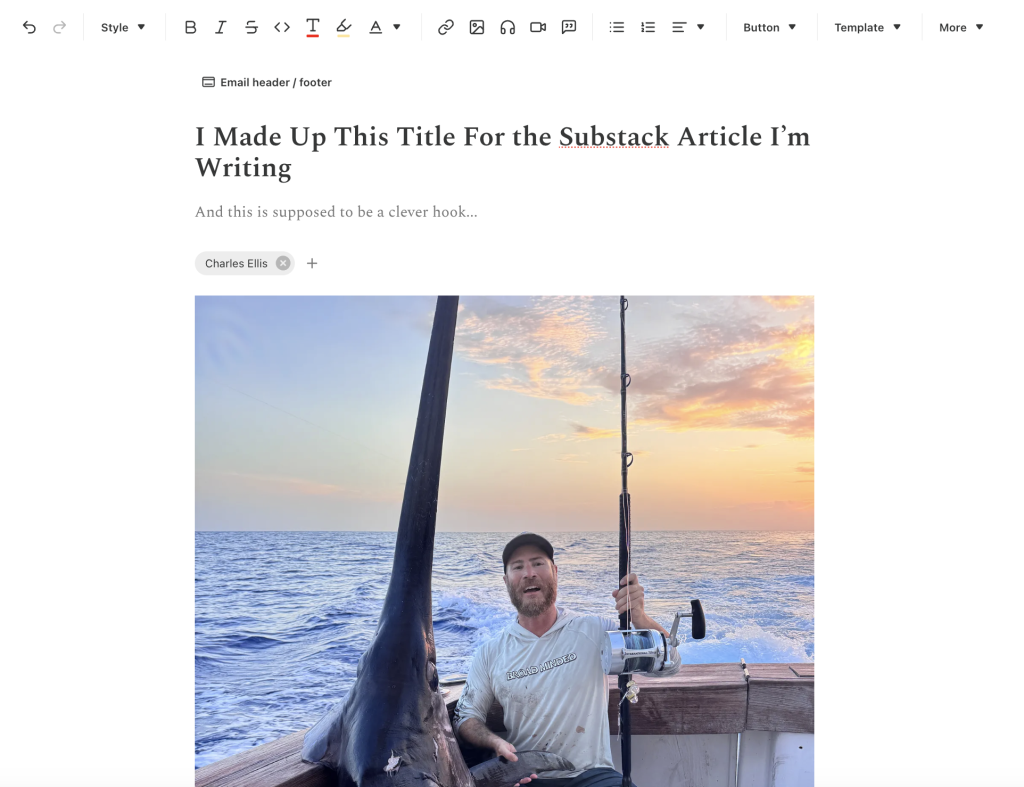
Most of the professional writers I’ve known, and media professionals of all varieties, write in Word, Google Docs, or Pages and then transfer their material into whatever platform they use to publish. But the essay editor on Substack reminds me of Blogger from the mid-2000s, which I loved for its simplicity, reliability, and ease of use. I can see why this is attractive to new writers, or people who are not overly familiar with building websites and publishing to WordPress, which has become one of the most complicated platforms for creative professionals to use.
One of the reasons social media flourished in the first place was its “ease of use”. Instagram enabled anyone with a fraction of a brain to take a picture and publish it to a public place where audiences from all over the world could see it and engage with it. That was a creative resource humanity was effectively missing – because prior to Myspace, Facebook, Instagram, TikTok, Reddit, etc – content creation and publishing was inherently difficult.
Creating a professional website or blog, for almost two decades, was an incredible effort. And typically an expensive one, if you didn’t want to showcase a wonky DIY website you cobbled together without substantial coding experience. WordPress has never, ever been particularly user friendly. The WordPress infrastructure that supports my website, GallantFish.com, is extremely complicated, and I use Elementor to format and publish blog posts that are typically elaborate. An “average” person who just wants to write essays and put them out for the world to see is served well by Substack, because it’s extremely minimalist when it comes to content creation.
I’ve also noticed that when people subscribe to your Stack, you build an email list. That is one of the key features of Substack – it affords you an audience that you actually own. If you build an email list that is 1,000 strong, or more – those are REAL people who enjoy reading your work. They want your essays in their inbox when they’re published (which Substack refers to as a “newsletter”). That’s a big deal. Particularly for aspiring writers.
It’s also worth noticing that this is the one part of Substack that doesn’t need a feed. An email list goes with you if you ever leave. Notes, likes, and restacks only work if you stay in the app.
In terms of the app’s functionality – it is smooth. It doesn’t glitch. It’s easy to jump around between topics, authors, and essays. Substack also gives you the opportunity to create your own “website”, even if it’s just a showcase of the content you produce, and there is a seamlessly integrated monetization system that lets you put a “paywall” around content you deem “premium”. I do see the value in this, because I’ve helped publishers build systems like this in the past – and it was a MASSIVE effort to create paywall protected content.
With Substack, for all intents and purposes, the ability to create and serve monetizable content is extremely accessible, intuitive, and streamlined.
…provided you can build an audience that is actually willing to pay to read your work, or look at your photos, or download your ebook – or whatever else you’re trying to sell as an informational product. And building that audience runs straight back to consistently publishing Notes.
Gross.
So where does that leave me, given how I started this editorial critique of a publishing platform that is clearly gaining momentum? Well – the truth of it – I’m still not sold on Substack. The publishing tools are good. It’s the layer built on top of them that I can’t get behind. There are too many characteristics of this platform that favor “influencer” level publishers. Substack clearly favors its largest “stacks”, because they are the ones that make the platform money.
The culture of “competition” to build an audience is taking form, a bit more every day, and it is frustrating to watch people from Instagram, TikTok, and Facebook simply adopt another platform to monetize their existing audience, and to arbitrage a new one.
I don’t like that I feel compelled to “figure out Substack” so that I can grow my audience.
I don’t like that I feel compelled to understand why certain publishers are successful, and why some are not. And I have yet to experience the “genuine connections” or “creative inspiration” that my friends and colleagues lauded as the reason for joining Substack in the first place.
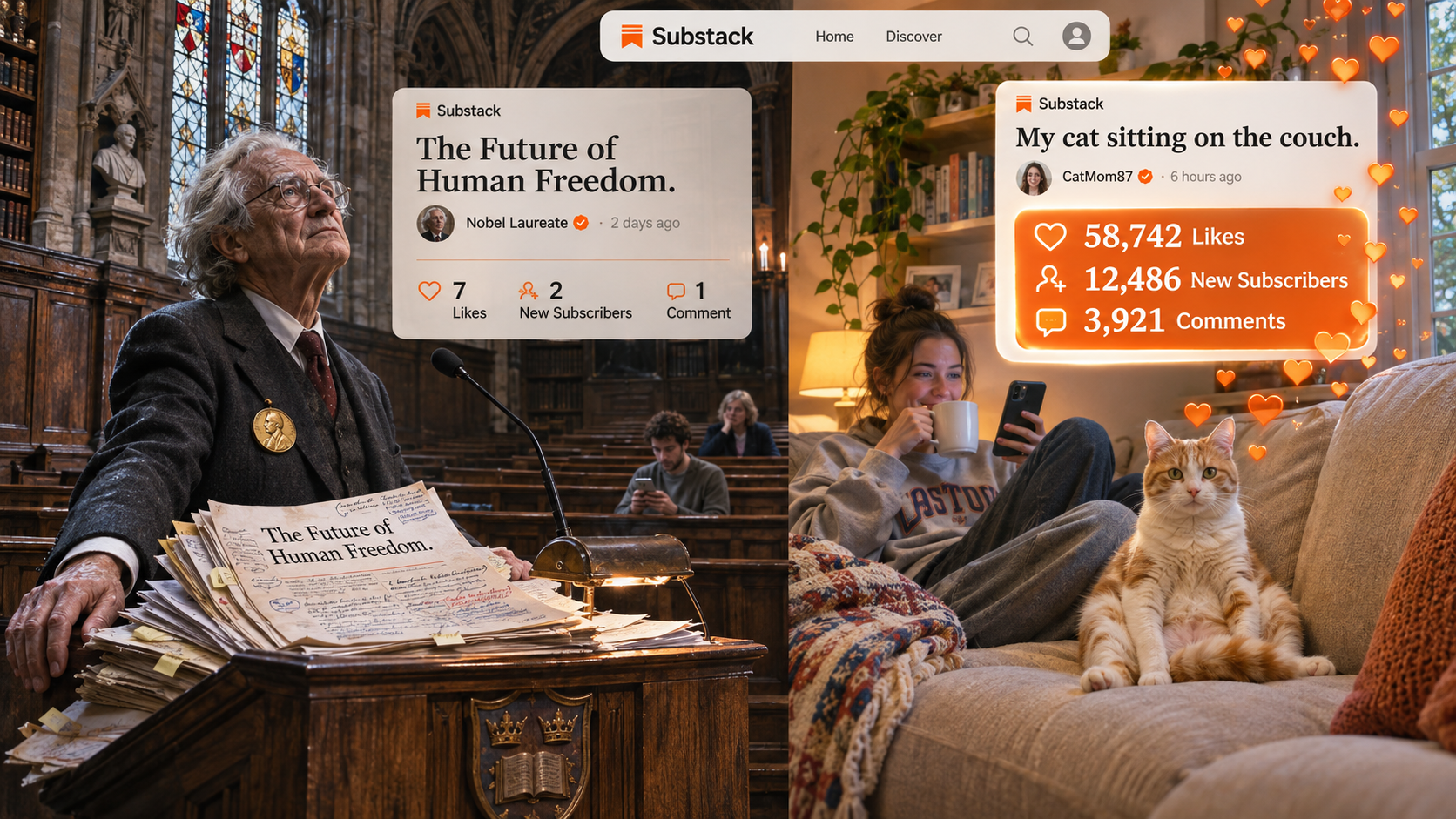
I really, really don’t like that someone can post a picture of a cat on a couch and suddenly have 1,000s of likes and subscribers, when there are genuinely compelling philosophical writers, brilliant poets, and extraordinary photographers publishing some of the best media I’ve seen in years – who get NO TRACTION WHATSOEVER.
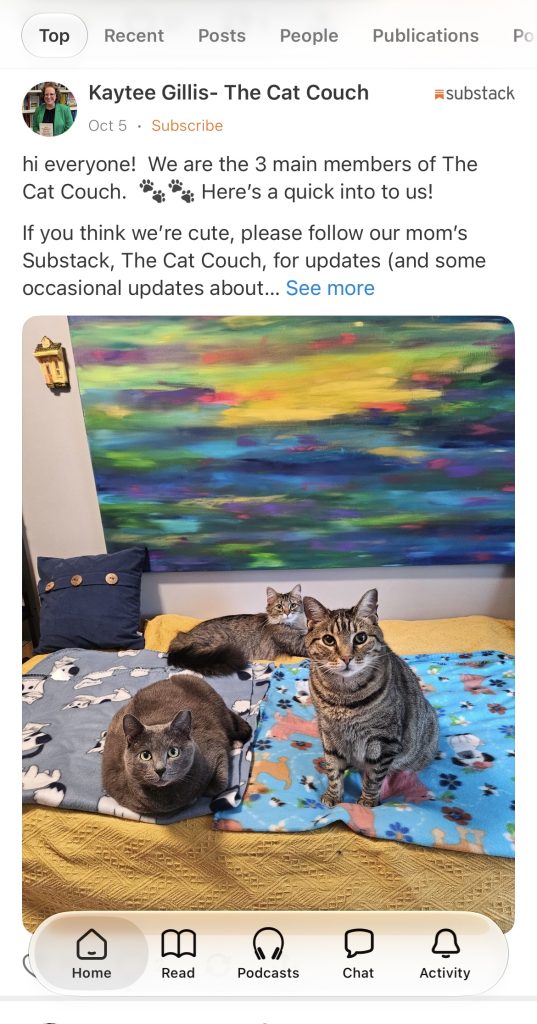
I have nothing against the cat.
My problem is with a feed that treats the cat and the essay as the same kind of thing, competing for the same attention, on a platform that was sold to me as the place where the essay wins.
I know some of this is a reflection of my own expectations for Substack, rather than what the platform actually represents. And I recognize that people are going to be people – the toxicity of social media shows up on every platform that “comes of age” or becomes popular. But platforms decide what to reward. Likes, restacks, subscriber counts, a feed that pushes whatever is already popular – somebody at Substack chose every one of those. So as someone who considers themselves a writer, an admirer of great authors and artists, and a new adopter of a platform that affords me the opportunity to put my thoughts and perspective out into the world – Substack has some work to do, if they intend to avoid becoming another forum overwhelmed with droves of self promoting, self indulgent, attention focused content creators.
I’d like to think there’s a way to emphasize the “creative forum” and “literary community” aspect of the platform, while minimizing the Instagramification of everything.
Am I going to continue using Substack? Probably. But just like I hit a breaking point with YouTube (after creating 95 full length travel videos over a decade), I don’t know if it’s something that will remain in my life, knowing the same addictive mechanisms are in place to keep me “engaged.”