



For the better part of two decades, ecommerce strategy rested on a tacit division of labor.
Search engines aggregated demand, and dominant marketplaces fulfilled it.
Brands acted as tenants in both domains. They earned or bought visibility in the first and paid transactional rent in the second, on the reasonable assumption that the arrangement, however costly, would remain stable.
That assumption no longer holds.
The generative turn in search has broken the link between query and click, and marketplace consolidation has turned the point of sale into a site of escalating rent extraction.
The ecommerce playbook, essentially, rested on two assumptions:. Google would send you shoppers, and Amazon would let you sell to them, for a fee.
Both assumptions are now under strain.
Google increasingly answers questions without sending anyone anywhere. Amazon has become less a sales channel than a toll road.
YouTube, often treated as a peripheral content repository, has become the primary infrastructure through which consumers acquire, evaluate, and circulate product knowledge. It is also among the few remaining venues where a brand can accumulate durable, proprietary audience capital. A substantial, sustained allocation of resources toward YouTube content and advertising is therefore not a matter of channel diversification. It is a structural necessity.
Over the past five years, YouTube has become the internet’s showroom, review desk, and word-of-mouth network rolled into one, and it is one of the few places where a brand can still build an audience it actually owns.

The Attenuation of the Search Referral
The informational economy of the open web depended on a reciprocal bargain: publishers supplied content, and search engines returned traffic. Generative summarization has unilaterally revised the terms. Pew Research found that users clicked a traditional search result in just 8% of visits when an AI summary appeared, compared with 15% when one did not. More rigorous still, a randomized field experiment reported by Search Engine Journal estimated that AI Overviews reduced organic clicks by 38% on the queries where they appeared, with zero-click searches rising from 54% to 72%
The implications for ecommerce are especially acute. The content that historically populated the upper funnel (the comparative review, the buying guide, the explanatory primer) is precisely the category of informational query that generative systems now absorb. The search engine has shifted from intermediary to terminus. Visibility endures, but it no longer converts into visitation.
Marketplace Concentration and the Enclosure of the Customer
At the other end of the funnel, transactional activity has consolidated to a striking degree. According to Marketplace Pulse data from February 2026, Amazon holds 35.7% of the $1.2 trillion US ecommerce market. For many categories, the marketplace is less a channel than a precondition of participation.
That centrality has a cost that exceeds fee schedules. The marketplace retains the customer relationship, controls first-party behavioral data, and monetizes the adjacency of competing listings through its own advertising apparatus.
The brand completes the sale but forfeits the relationship.
It captures revenue, in other words, while ceding the informational and relational assets from which long-term brand equity is built. If consumer affinity is formed anywhere, it is formed upstream of the transaction, and the question is where.
Why YouTube’s Growth Is a Harbinger for Advertisers
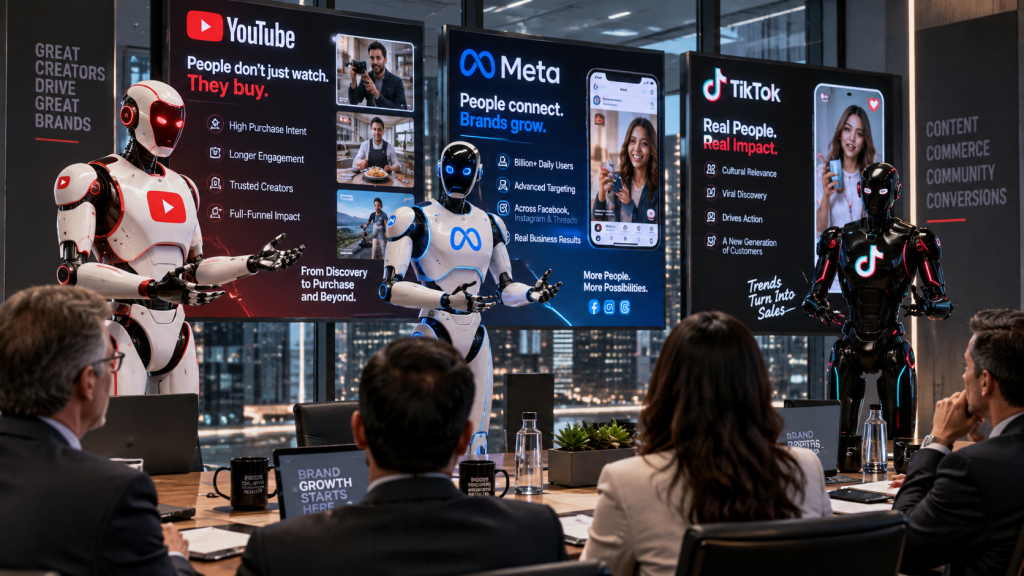
YouTube’s trajectory since 2020 represents less incremental growth than a change in kind. Its advertising revenue, just under $20 billion in 2020, reached $40.367 billion in fiscal 2025, per Alphabet’s annual report. Including subscription revenue, YouTube’s 2025 total exceeded $60 billion, surpassing Netflix, as Variety documented. The short-form format grew even more steeply: in March 2021, Shorts generated 6.5 billion daily views; by June 2025, YouTube reported that figure had surpassed 200 billion.
The most consequential development, however, is not scale but migration to the television screen, the historical seat of mass-market brand building. In Nielsen’s May 2026 Gauge, YouTube recorded a platform-best 13.8% of television watch time, holding the largest share of any distributor for a third consecutive month, up from a 10.8% share in the comparable period a year prior. YouTube has become a hybrid medium, combining the reach and lean-back attentional mode of broadcast television with the addressability and measurability of digital media.
Discovery, Diligence, and the Victory Lap
YouTube matters to ecommerce because it serves every stage of a purchase, often in the same session.
- Discovery. The recommendation engine puts products in front of people who didn’t know to search for them. Among Gen Z users aged 14 to 24, 61% say YouTube has helped them find brands or products they didn’t know about.
- Research and vetting. This is where YouTube quietly beats both Google and Amazon. A 1,200-word review can say a blender is quiet. A video lets you hear it. Research from Pixability found that YouTube ranks as the top destination for product reviews and product information among all consumers, including Gen Z. The same research reports that YouTube’s influence shortens the average online video shopper’s journey by six days.
- Purchase confidence. A Google and Kantar study covered by PPC Land found that 79% of surveyed Gen Z viewers in the US trust creator recommendations on YouTube, and 74% say creators provide context or expertise that helps them buy with more confidence.
- Showcasing. Then there is the victory lap: the unboxing, the “six months later” follow-up, the haul. These videos work as a permanent, searchable archive of social proof, and they tend to be most persuasive precisely because the brand didn’t make them. YouTube’s own shopping ecosystem report notes that creators have long built shared shopping experiences through unboxings, hauls, and reviews, and those interactions are now directly shoppable.
YouTube has also built the commerce plumbing to match the behavior. Users watched more than 35 billion hours of shopping-related content on YouTube over the past year, a 250% year-over-year increase. The Shopping affiliate program has expanded quickly too, and is now open to all YouTube Partner Program creators with at least 500 subscribers who meet eligibility guidelines. Every creator who reviews your category is now a potential storefront.
The Case for Real Investment in YouTube Content and Ads

The logic here is simple. Search traffic behaves like rent: you pay for it again every month, and the landlord keeps raising prices. A YouTube audience behaves more like equity. A subscriber base, a library of evergreen tutorials, and a catalog of comparison videos keep compounding. They keep ranking in YouTube search, surfacing in recommendations, and increasingly appear inside the Google results that are eating your blog traffic.
A serious commitment has three parts:
First, build a content library around real buying questions: setup guides, “is it worth it” breakdowns, honest comparisons, and care-and-maintenance videos. These videos serve people who have already decided to buy, and people who are one objection away from deciding.
Second, use Shorts as the discovery layer, feeding viewers toward the longer videos where persuasion actually happens.
Third, treat advertising as an accelerant, not a substitute. YouTube ads work best when they amplify content that has already shown it can hold attention, and when they retarget people who watched your organic videos or visited your site. For a deeper framework, Google’s own YouTube Formula for 2026 outlines how brands can combine cultural relevance, AI-driven creative, trusted creators, and cross-screen measurement. Pixability’s brand playbook and SocialEz’s complete guide to YouTube marketing are also worth your strategy team’s time.
Collaboration as the Transfer of Trust
Audience formation from first principles is slow; collaboration accelerates it by transferring credibility. A brand featured by an established creator inherits, provisionally, the trust that creator has built with viewers over years of consistent engagement.
YouTube has formalized this transfer. A collaboration feature introduced in August 2025 lets creators tag partners on individual videos, triggering recommendations across the combined audiences of all tagged channels. Through Open Call, brands can publish creative briefs, receive tailored video submissions, and promote accepted work as partnership ads with performance monitoring. These capabilities have since been consolidated under a unified Creator Partnerships platform, which adds improved matching along with Media Kits and Open Calls. The strategic significance of partnership ads is that they make authenticity scalable: paid distribution can be layered onto an endorsement whose persuasive power rests on its not reading as advertising.
Analytics as Audience Epistemology
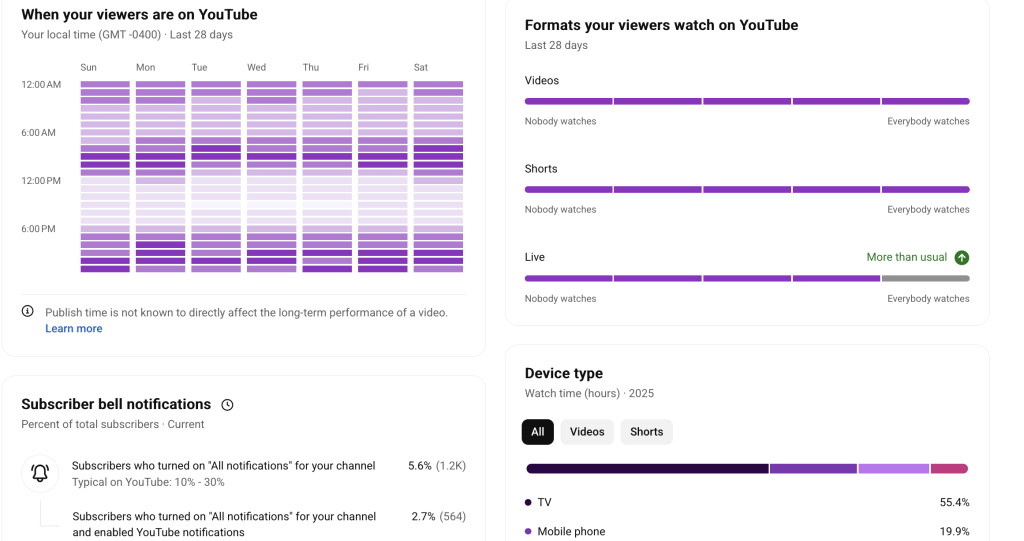
YouTube’s analytics dashboard allow a brand to move from inference to observation about its audience. The Audience report in YouTube Studio breaks viewership down by age, gender, geography, and device. The device dimension now carries real strategic weight: television-dominant audiences favor extended, lean-back formats, while mobile-dominant audiences demand compressed openings and short-form entry points. The report on other channels one’s audience watches effectively supplies an empirically derived map of adjacent communities, and with it a data-grounded shortlist of prospective collaborators.
The distinction between unique and returning viewers separates genuine expansion of reach from the repeated re-engagement of an existing constituency. Traffic source attribution shows whether the channel is functioning as a discovery engine or merely a hosting service. Audience retention curves offer second-by-second evidence of where persuasive intent fails, a granularity of feedback that would once have required costly qualitative research.
On the paid side, audience reporting and brand lift studies measure movement in awareness, consideration, and purchase intent rather than mere exposure.
Together, these instruments yield what neither search nor marketplace analytics provides: a longitudinal, empirically grounded account of the composition, magnitude, and growth of a brand’s audience.
Collaborations With Established YouTube Creators Can Accelerate Audience Growth
Building a meaningful YouTube audience takes time.
Brands do not necessarily need to build every part of that audience independently.
Established YouTube creators have already done something extraordinarily difficult: they have accumulated attention and trust among clearly defined groups of people.
Strategic collaborations can allow ecommerce companies to borrow that distribution.
The opportunity extends considerably beyond basic influencer marketing.
Brands can sponsor episodes, provide products for independent demonstrations, collaborate on educational content, participate in creator projects or invite respected creators to contribute to videos appearing on the brand’s own channel.
The key question is straightforward:
Which creators already have the audience we want to reach?
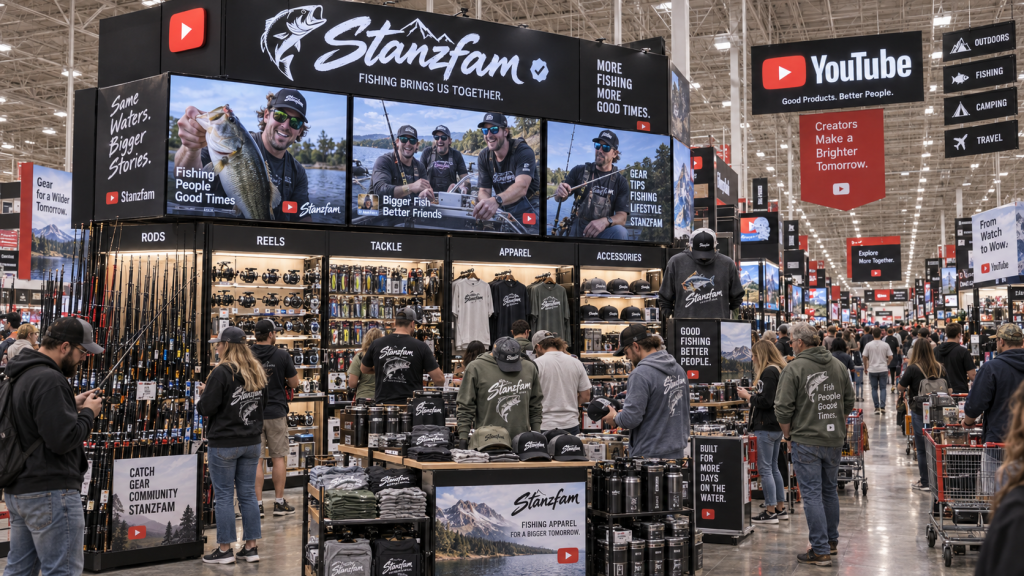
A fishing-equipment company should know which fishing channels its customers watch.
A kitchen brand should know which chefs and culinary creators influence its buyers.
A luxury travel company should understand which travel channels reach affluent travelers.
A home-improvement manufacturer should understand which contractors, builders and DIY creators command meaningful audiences.
YouTube collaborations provide both immediate exposure and long-term content value because a well-performing creator video may continue generating views years after a traditional advertising campaign has ended.
For brands exploring this approach, Sprout Social’s guide to YouTube influencer marketing provides additional context around creator partnerships and campaign planning.
What does all this mean for YouTube Marketing Strategy in 2027?
The two pillars of conventional ecommerce strategy are undergoing parallel erosion: search is becoming an answer engine rather than a referral mechanism, and the dominant marketplace has become an increasingly extractive intermediary. YouTube occupies the interstitial space in which consumer knowledge is now produced, contested, and shared. Brands that treat it as ancillary will remain dependent on attention rented from others. Brands that invest substantively in content, strategic amplification, and trust-transferring collaboration will build something increasingly rare in digital commerce: an audience that is genuinely their own.