


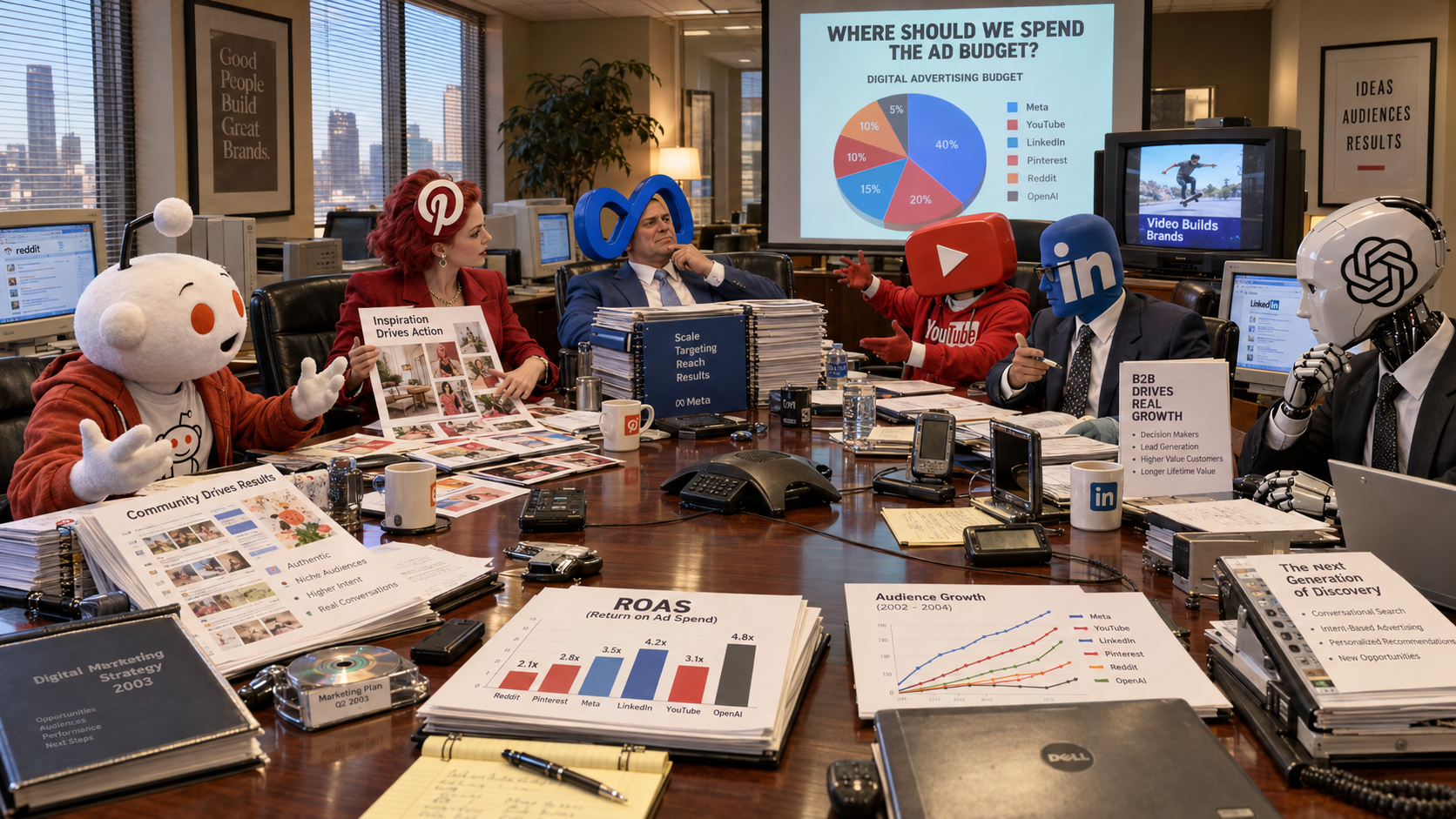
I’m sick of Meta Ads.
And if you’re reading this, it’s a reasonable gamble you are too.
I’ve honestly lost count of how many prospective clients i’ve spoken with who lost a fortune on Meta Ads, only to have their agency of record mercilessly defend the initiative under the guise of “brand awareness” or “top of funnel” audience prospecting.
Truthfully, despite my deep-seated disdain for all things Facebook and Instagram, there was a time when Meta Ads could make a competent eCommerce marketer feel distinctively intelligent.
The process to achieve laudable success with Facebook Ads was irrefutably straightforward: Find an attractive audience, produce a respectable ad, install the pixel, let Facebook locate more people who behaved like your customers, then watch the purchases arrive.
The situation is somewhat more complicated now, to say the least.

Meta remains one of the world’s most consequential digital advertising platforms, and Facebook and Instagram can still produce exceptional results for the right advertiser. But the advertising proposition is considerably less novel than it was a decade ago. Auctions are crowded. Customer-acquisition costs can be unforgiving. Targeting has changed. Attribution has become murkier. Creative fatigue arrives faster, forcing brands into an increasingly demanding production cycle.
Consider the modern social media advertiser’s principal pain point. A vertical video wins for twelve days, then quietly expires. The team produces the nineteenth variation of that video, because the algorithm is insatiable and the previous winner has been fully digested. A Meta Ads account representative suggests that one more campaign restructure (consolidation this time, after last quarter’s segmentation) will finally deliver the astounding success an entire marketing department is yearning to achieve. Auctions are more crowded than they were five years ago, customer-acquisition costs have drifted upward, creative lifecycles have shortened, and attribution has become an exercise in choosing which model you would prefer to believe.

Let me take a step back from my inherent disgust of social media to make one point very clear: none of this means Meta Ads “don’t work.” It means many brands have built customer-acquisition strategies in which a single algorithm is expected to generate awareness, consideration, conversion, retention and most of the quarterly revenue forecast, all from one interruptive feed, fed by creative produced on an industrial schedule. That is a great deal to ask of one channel, and when it wobbles, the entire P&L wobbles with it.
The useful question is therefore not “what platform can replace Meta?” There isn’t one, and anyone promising otherwise is selling something. The better question is: which advertising environment gives this particular message, product, audience and stage of the buying journey the greatest advantage? Framed that way, the alternatives to Meta Ads stop looking like substitutes and start looking like a portfolio. Each of the five platforms below places a message in a different psychological environment: people researching inside communities, planning a purchase visually, watching and comparing, evaluating a professional decision, or asking an AI for an answer. Those are not five versions of scrolling. They are five different jobs, and a serious paid media strategy balances them tactfully.
Reddit Ads: The Opportunity to Engage Consumers Inside High-Intent Communities
Reddit is not a social network in the Facebook sense of things. Nobody follows their cousin on Reddit (one can imagine the horror if they did). The inherent context of Reddit, which makes it so powerful, is that global audiences gather in subreddits around interests so specific that a mainstream feed would never surface them: mechanical keyboards, sourdough starters, ultralight backpacking, index-fund investing, one model year of one car. The audience mindset is inherently skewed to research and conversation rather than passive scrolling, and Reddit’s own numbers reflect that. The company reported 130.3 million daily active uniques and 514.6 million weekly in its Q2 2026 results, and has told investors that roughly 40% of conversations on the platform are commercial and that more than 80 million people search Reddit each week (Q4 2025 earnings call).
That positions Reddit Ads as unusually useful for products people research before buying: consumer electronics, outdoor gear, gaming hardware, software, specialty eCommerce and, with appropriate care, financial products. The formats fit the behavior. Promoted posts sit in the feed; the conversation placement runs beneath a post and above the first comment, exactly where someone is reading other people’s opinions; and Dynamic Product Ads pull catalog items into those threads, now with a Shopify integration and the Reddit Max automation layer that Reddit says is cutting CPAs (Q2 2026 shareholder letter). Targeting spans communities, interests, keywords and custom audiences (Reddit audiences), with the Reddit Pixel and Conversions API handling measurement, alongside on-platform brand and conversion lift studies.
Sounds great, right? Despite the compelling value proposition of Reddit Ads, there is an infamous limitation that remains pervasive no matter which subreddit you decide to target: Redditors have the most sensitive advertising detectors on the internet, and a Facebook creative with a stock photo and a “Shop Now” button will be downvoted into oblivion or, worse, commented on.
No marketer should ever be asked endure the brutality of a unified assault by furiously sarcastic and spiteful redditors.
The funnel position of Reddit, as a platform, is mid-to-upper: discovery and research rather than last-click conversion, which means ROAS measured on a seven-day click window will understate Reddit’s contribution. Judge it on assisted conversions, brand search lift and new-customer rate instead, and expect the payoff to arrive later than Meta’s.
Key Insight: Build creative for communities, not for “Reddit.” A campaign targeting r/BuyItForLife, r/Coffee and r/Frugal is three campaigns, each with its own headline vocabulary, its own offer logic (durability, extraction quality, price per cup) and ideally its own landing page that continues the conversation the ad interrupted. Contextual relevance is the lever here: people who land on a page that speaks their subreddit’s language convert at rates a generic page simply cannot match, and the comment thread beneath your ad becomes an asset rather than a liability.
Pinterest Ads: Capturing Demand While Shoppers Are Still Planning or Seeking Inspiration
Pinterest is usually filed under “social media,” which inherently misrepresents the behavior of its dedicated purpose. Users do not spend hours on Pinterest to see what friends are doing. Instead, they go in search of inspiration: ideas to renovate a kitchen, a chance to discover creative wedding favors, innovative seasonal fashion trends, variations of traditional recipes for a holiday occasion. Pinterest is a visual search and planning engine with commercial intent built in.
Pinterest reported 640 million monthly active users for Q2 2026, and CEO Bill Ready told the September 2026 Pinterest Presents event that the platform handles more than 80 billion searches a month, most of them visual, more than half commercial, and over 96% of them unbranded (Pinterest newsroom). Unbranded is the operative word.
These are shoppers who have a project but not yet a brand.
The strongest categories are the ones you would likely guess: home décor, furniture, fashion, beauty, food, weddings, travel, DIY, gardening, wellness, gifts and anything seasonal, because all of them involve a planning phase that Instagram compresses and Pinterest stretches. The formats follow suit: standard and video Pins, carousels, collections (a hero image above shoppable tiles), shopping ads fed from a catalog of up to 20 million products, showcase and quiz ads (ad specs), and, since September 2026, Visual Search Ads inside search results and Pin close-ups (announcement). Performance+ campaigns automate targeting and bidding, including ROAS bidding and a new-customer-acquisition goal, while measurement runs through the Pinterest tag, the Conversions API and conversion lift studies.
Pinterest’s weakness is also its character: the consideration cycle is long. Someone saving kitchen ideas in February may not order a faucet until May, so a seven-day attribution window makes Pinterest look expensive and a 60-day view makes it look prescient. Impulse categories and products with no visual dimension struggle here, and while Pinterest says Gen Z is now more than half its audience, the user base still skews female, which is a feature for some advertisers and a ceiling for others.
Key Insight: Advertise upstream of the purchase. The ROAS opportunity is reaching people while they are assembling a board, not when they finally type a product name into a search engine where every competitor is bidding. Use Pinterest Trends to see when searches for your category begin rising, which is typically months before the season or life event, then launch creative that fits the planning moment (“small bathroom ideas,” not “buy this vanity”) and run catalog retargeting against people who saved or engaged. You are buying a position on a wish list before anyone else is paying for the final click.
YouTube Ads: The Most Effective Strategy to Engage Audiences in a Research and Demonstration Stage

YouTube is the most strategically important alternative to Meta Ads because it is several platforms at once: an entertainment service, the world’s second-largest search engine, a review ecosystem, a classroom, a creator economy and, increasingly, television. Google says viewers watch more than a billion hours of YouTube on TV screens every day (Google), and Shorts now run at roughly 200 billion daily views (YouTube CEO letter, January 2026). The person watching a 20-minute comparison of espresso machines is in a fundamentally different mental state from the person thumbing past a Reel.
They are researching, and they will tolerate, even welcome, a longer argument.
The formats available through Google Ads are correspondingly broad: skippable and non-skippable in-stream, six-second bumpers, in-feed ads in search results and recommendations, Shorts ads, mastheads and connected-TV placements including pause ads (format overview).
Video action campaigns have been folded into Demand Gen, which runs across YouTube, Discover and Gmail, supports lookalike audiences and can attach Merchant Center product feeds so a demonstration video carries a shoppable carousel. Targeting includes in-market and affinity segments, Customer Match, video remarketing lists built from your own channel’s viewers, and custom segments built from what people have searched on Google and YouTube, a search-intent signal Meta simply does not possess. Measurement extends past last click with Brand Lift, Search Lift and Conversion Lift studies.
The implementation limitations are perhaps more tangible than any other advertising platform. Good video is expensive to produce, the campaign interface is complex, and Google’s automation increasingly steers budget toward its own objectives. Premium CTV inventory is not cheap. But cheap media was never the point. YouTube’s ROAS case rests on higher conversion rates from educated buyers, larger baskets for considered purchases, and measurable lift in branded search, which Google now reports as an attributed branded searches metric. Paid video also compounds with organic: an ad that sends a viewer to a channel full of tutorials keeps working long after the impression is paid for.
Key Insight: Stop asking one 30-second commercial to do every job. Build a video ladder that matches the viewer’s research stage: a six-second bumper for discovery, a 15-second in-feed hook placed beside competitor reviews for evaluation, a two-minute demonstration for consideration, an objection-handling piece (“is it worth the price?”) for the hesitant, and a short product-feed remarketing ad for anyone who watched half the demo. Sequence them with remarketing lists so each viewer receives the next argument rather than the same one. Conversion efficiency rises because the message finally matches the question in the viewer’s head.
LinkedIn Ads: Precise Targeting for High-Value Professional Audiences
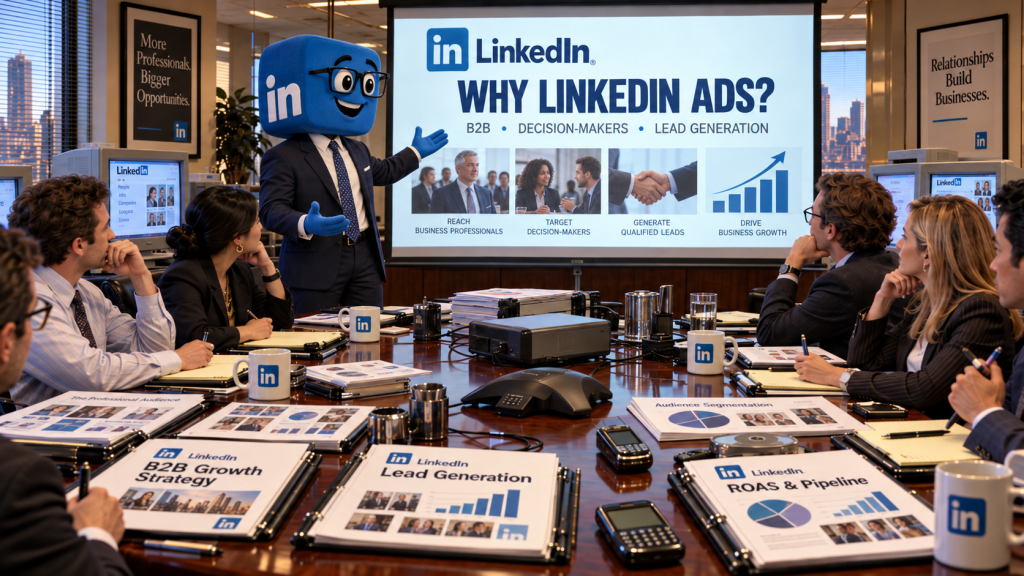
The lazy description of LinkedIn Ads is “Facebook for B2B,” and it is wrong in the way that matters most. Meta infers who you are from behavior; LinkedIn knows what you do because you told it, on a profile you keep accurate for career reasons.
That professional identity graph, which LinkedIn puts at more than a billion members including 63 million decision-makers and 10 million C-level executives (LinkedIn Marketing Solutions), allows targeting no consumer platform can reproduce: job title, job function, seniority, industry, company name and company size, plus skills and groups.
Matched Audiences layer on uploaded company lists for account-based marketing, contact lists and website retargeting, and since lookalikes were retired in 2024, Predictive Audiences expand from a seed list instead.
The formats support both ends of the funnel. Sponsored Content covers single image, video, carousel and document ads; Thought Leader Ads let a company sponsor an executive’s or employee’s own post, which tends to earn the attention a logo cannot; Lead Gen Forms pre-fill from profile data; and Connected TV ads extend B2B reach into the living room (ads guide). Measurement includes the Insight Tag, a Conversions API and the Revenue Attribution Report, which joins campaign exposure to closed-won revenue in Salesforce, HubSpot or Zoho, the only metric a CFO will eventually care about.
Sounds ideal doesn’t it? Unfortunately for you – it is expensive. CPCs and CPMs run several multiples of Meta’s, and evaluating LinkedIn with a consumer-media yardstick will always make it look like a bad deal. That yardstick is wrong for the advertisers who belong here: B2B SaaS, enterprise software, professional services, financial services, consulting, recruiting, executive education and high-value business products with five- or six-figure contract values and sales cycles measured in quarters.
For a $40 consumer product LinkedIn is absurd.
For a $60,000 annual contract, a $300 qualified lead is a rounding error.
The genuine weaknesses exist elsewhere within the platform: a narrow audience exhausts quickly, frequency climbs, and creative that reads as corporate wallpaper is ignored by exactly the senior people you paid to reach.
Key Insight: Work the economics backwards, never forward from CPC. Start with customer lifetime value, derive the acceptable customer acquisition cost, apply your opportunity-to-close rate to find what a qualified opportunity is worth, then your lead-to-opportunity rate to find the lead cost you can afford. That number, not Meta’s $1.50 click, is the benchmark. Then narrow aggressively. A campaign aimed at 4,000 VPs of finance at target accounts with 500 to 5,000 employees costs more per impression than a broad “business decision-makers” audience and produces dramatically better pipeline per dollar, because in B2B the buying committee is the unit of value, not the click.
OpenAI Ads: The “Promised Land” of ChatGPT Advertising
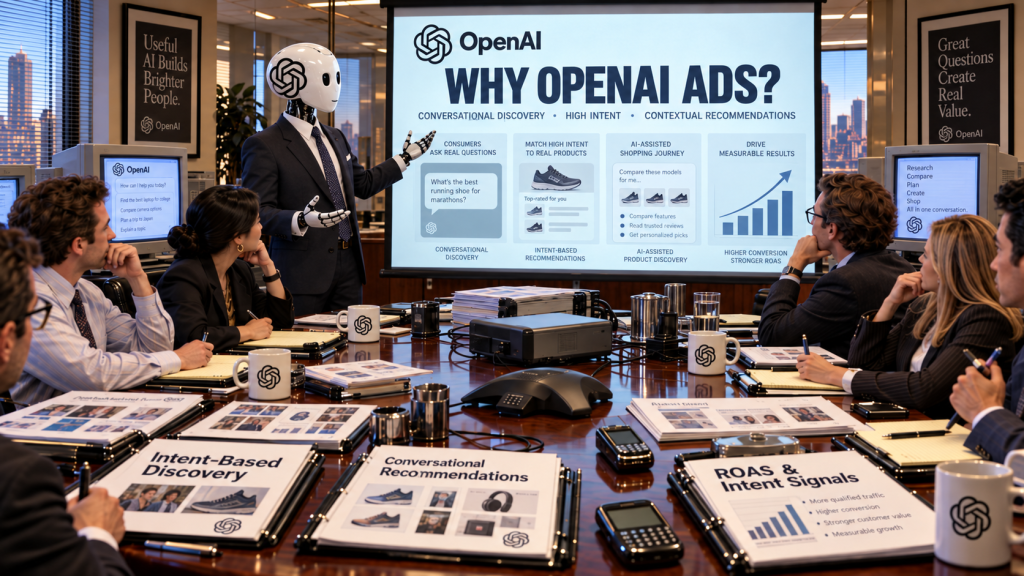
Advertising on ChatGPT has so much potential it honestly belongs at the top of this list, but the reality is, the advertising aspect of ChatGPT isn’t quite ready to take ranks with Google Ads or other veteran self-service advertising solutions. Precision matters more than enthusiasm in this current circumstance. Here is what exists as of October 2026…
OpenAI began testing ads in ChatGPT in the United States in February 2026 and has since expanded to more than 60 countries. Ads appear only to logged-in adults on the Free and Go tiers; Plus, Pro, Business, Enterprise and Edu accounts do not see them (help center).
The generally available format is a single native unit shown below the end of a response, carrying the advertiser’s name, a headline, a description, an image and a link (the basics). Buying runs through a managed sales team and agency partners, or through a self-serve Ads Manager that OpenAI still labels beta, priced in a relevance-weighted second-price auction on a CPM, CPC or conversion basis with a suggested starting CPC of $3 to $5. Measurement includes a pixel, a Conversions API and integrations with the usual attribution vendors (October 2026 update). A visual format alongside image generation is in testing, and OpenAI describes its incrementality and brand-suitability pilots as early-stage.
Targeting is where the environment departs from everything else here. OpenAI’s documentation describes matching on conversational context, the ad’s copy and landing page, and advertiser-supplied “context hints” that are explicitly not keywords and not guaranteed. There is no documented demographic targeting. OpenAI also states that ads do not influence answers, that conversations stay private from advertisers, and that no ads run near health, mental-health or political conversations (OpenAI’s approach to advertising; ad policies).
Why pay attention to OpenAI Ad as a platform? Because the user’s mindset is neither scrolling nor browsing.
Someone asking an AI to compare two standing desks, plan a week in Lisbon or explain whether they need umbrella insurance has stated a problem and a pending decision in plain language. An ad unit sits beside a question rather than beside an inferred interest, which is a different proposition from anything in a social feed. The limitations are equally as plain: inventory is confined to free tiers, the format is one unit, scale and benchmark data are thin, and whether people welcome ads inside what feels like a private conversation is a question OpenAI itself is still answering.
None of this means OpenAI Ads will outperform established channels. It means the environment deserves a seat at the planning table.
Key Insight: Think in decision contexts, not demographics. Within what the platform supports today, that means writing ads and landing pages that answer the kind of question likely to surface them (“which running shoe for flat feet and a marathon in twelve weeks?”) rather than recycling a brand headline, and using context hints to describe the problems your product solves instead of the audience you imagine buying it. Any finer alignment to specific intents remains a strategic consideration, not a feature OpenAI offers, so fund this as a learning budget judged on incrementality rather than as a scaled performance channel.
Comparing the Five Meta Ads Alternatives
These five digital advertising platforms solve different marketing problems. Treating them as substitutes for one another, or for Meta, does not constitute a consolidate strategy.
Platform | Strongest advertising advantage | User mindset | Particularly strong for | Primary ROAS opportunity |
|---|---|---|---|---|
Reddit Ads | Community and conversation relevance | Researching, discussing, seeking recommendations | Niche, enthusiast and research-heavy products | Contextual alignment with specific communities |
Pinterest Ads | Visual planning and unbranded search | Planning, gathering inspiration | Lifestyle and visual commerce, seasonal categories | Influence before the final search |
YouTube Ads | Explanation, demonstration and CTV scale | Watching, researching, comparing | Products that need to be explained or shown | Multi-stage video sequencing |
LinkedIn Ads | Declared professional identity | Evaluating business decisions | High-value B2B with long sales cycles | Precise commercial audiences and pipeline value |
OpenAI Ads | Proximity to a stated question or decision | Asking, comparing, deciding | Early learning in conversational discovery | Relevance to active decision contexts (still emerging) |
Notice what the table does not contain: a column for cheapest CPC. On that measure Meta would win most rows, and it would tell you almost nothing about which channel produces profitable incremental revenue for your product.
Diversification Beats Platform Dependency
Diversification does not mean dividing the budget into five equal slices and calling it a strategy. That is dependency with more spreadsheets. High efficacy media diversification starts with the customer’s path and asks where each stage actually happens: where people discover they have a problem, where they look for inspiration, where they research solutions, where they compare products, where they validate the decision with other humans, and where they finally convert. Then it places advertising in those environments, with creative built for each, and measures each channel on the job it was given rather than on one blended ROAS that flatters whichever platform sits nearest the checkout.
In that portfolio, Meta very likely remains. It is still an efficient conversion and retargeting engine for many eCommerce advertising programs, and for some brands it will remain the largest line item in the advertising budget. But it plays a role rather than being the plan.
The danger was never Meta itself; it was allowing one algorithm’s auction dynamics, creative appetite and attribution model to become the entire customer-acquisition strategy, so that a CPM increase or a policy change in Menlo Park became an existential event in your boardroom.
The search for alternatives to Meta Ads, in other words, is not about abandoning Meta. It is about recognizing that discovery, research, influence and purchase now happen across a far wider ecosystem of eCommerce advertising platforms, and allocating dollars accordingly.
The financial discipline that makes this work is simple to state and rarely practiced: distinguish cheap media from efficient media. A $0.90 click that converts at 0.8% into a single $40 order is not cheaper than a $9 click that converts at 6% into a customer worth $1,200 over three years. Judge channels on contribution margin, customer lifetime value, incrementality, repeat purchase, sales-cycle length and, for B2B, qualified pipeline, and the “expensive” platforms on this list start to look considerably more reasonable, while some of the cheap ones start to look like what they are.
The future of performance marketing is unlikely to be about discovering another platform that behaves exactly like Facebook and Instagram did during their most profitable years. That era rewarded one skill, feeding one algorithm, and it is not coming back.
What replaces it is an assembled portfolio of advertising environments in which different platforms do different jobs exceptionally well:
- Reddit for community credibility
- Pinterest for early influence
- YouTube for persuasion
- LinkedIn for commercial precision
- Conversational AI for proximity to the decision itself.
Brands that build that portfolio gain broader visibility, more resilient customer acquisition and, because each dollar is finally placed where it has an advantage, a far better chance of maximizing ROAS than any search for the next Meta could ever provide.